Key facts
- What it is
- High-intensity focused ultrasound: heat at small points, at set depths, beneath an intact surface
- Face cartridge depths
- Ultraformer MPT: 1.5, 2.0, 3.0 and 4.5 mm; 4.5 mm reaches the SMAS
- Imaging
- Ultherapy Prime images the tissue before each line; Ultraformer MPT sets depth by cartridge
- Suits
- Early to moderate laxity of the jawline, under the chin and across the neck
- Does not do
- Replace lost volume, reduce a full fat pad or remove redundant skin
- Shot counts
- Not comparable between devices; the plan follows the tissue, not a number
- Fee
- Depends on area, depths, number of lines and combinations; set after assessment
1. Is my face suited to HIFU, or does it need something else?
HIFU suits laxity: skin and the deeper SMAS layer that have loosened in a face whose underlying fat is neither markedly excessive nor depleted. Early to moderate descent along the jawline, under the chin and across the neck is the usual starting point. Most people who ask for HIFU are describing a look rather than a layer, and the same look can come from laxity, from lost volume or from a full fat pad. Each needs a different answer.
A hollow midface or temple sags because volume has gone, and heating the SMAS does not replace it. A full submental fat pad calls for a different mechanism, and a heavy lower face with a great deal of redundant skin is beyond any energy device, so a thread lift or a surgical opinion may be the honest answer. Because focused ultrasound is absorbed at depth rather than by melanin in the epidermis, Fitzpatrick III to V skin, the range most common in Singapore, is not subject to the pigment considerations of some light-based devices. Suitability still depends on laxity, facial fat, implants and medical history, which an examination settles.
A quick self-check from the jowls guide gives a first impression. Tilt your chin down and clench your teeth: tissue that folds over the jawline suggests descent, softness that stays even with the head held high suggests fat, and vertical neck bands that tighten when you grimace point to the platysma, which is a neck problem rather than a jowl. It is a screening observation, not a diagnosis.
2. Which depths does HIFU reach, and why do they matter?
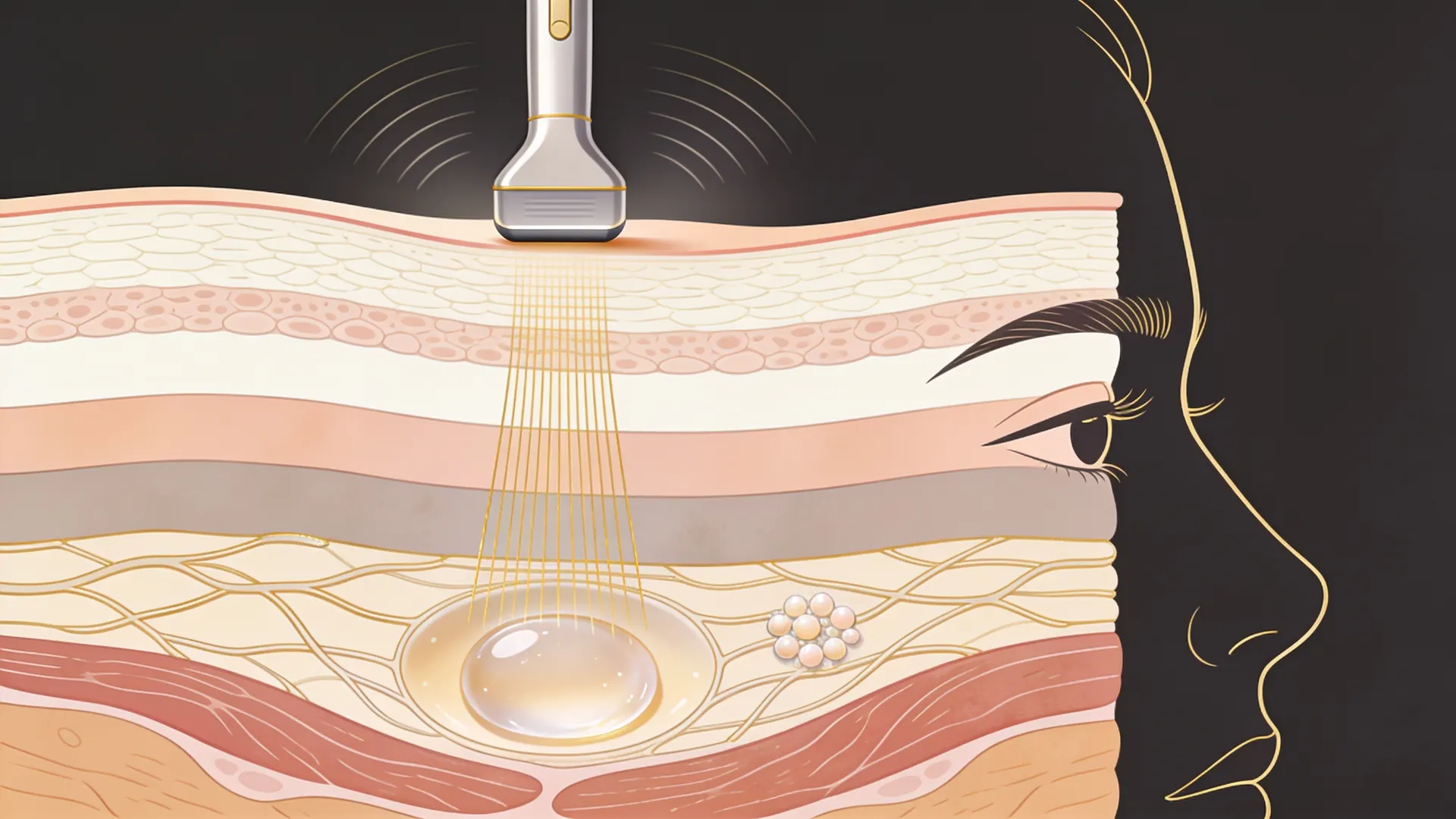
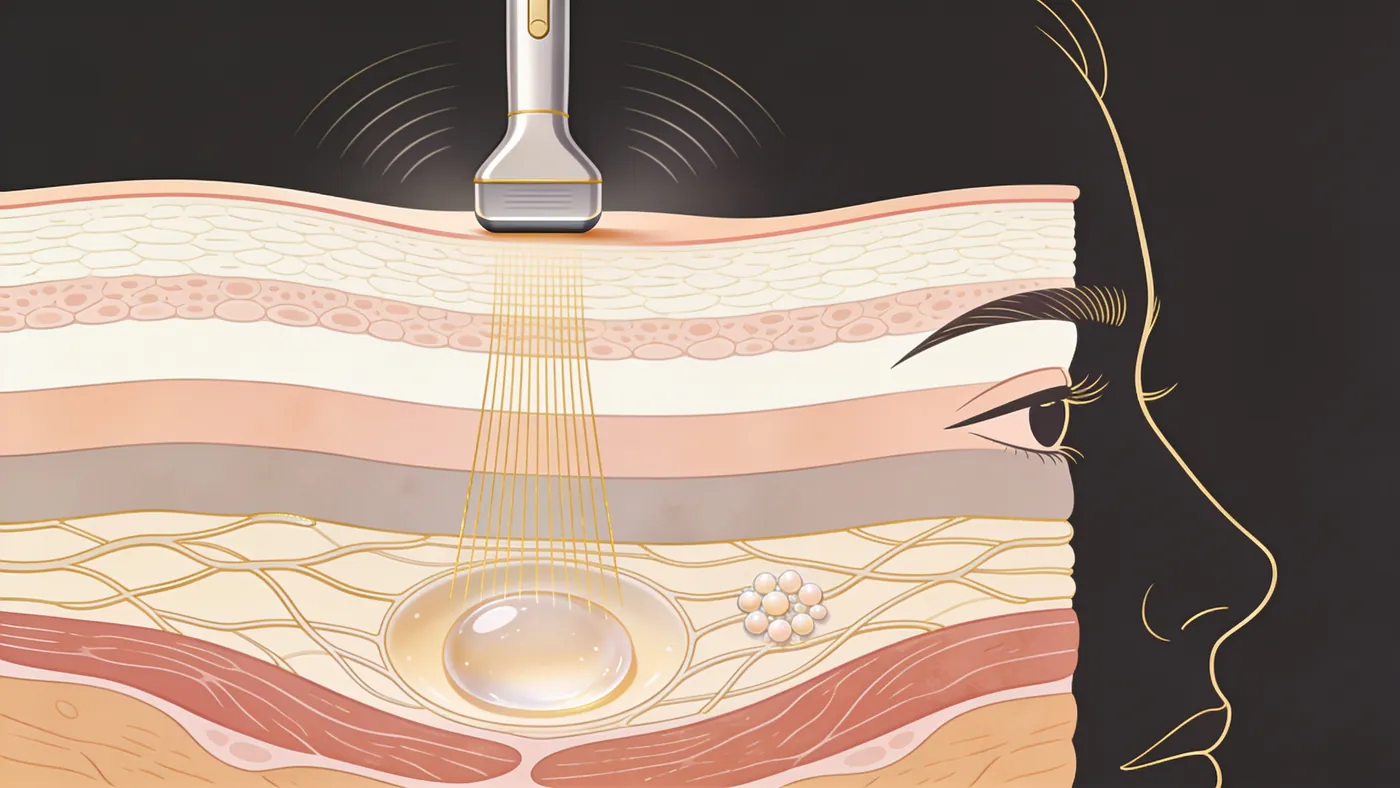
HIFU converges ultrasound at a set depth so that a small point of tissue reaches roughly 60 to 70 °C while the surface is spared. On the Ultraformer MPT the face cartridges work at 1.5, 2.0, 3.0 and 4.5 mm. At 4.5 mm the target is the SMAS, the fascial layer a surgical facelift repositions; at 3.0 mm it is the dermis, and at 1.5 mm the superficial dermis. Body cartridges reach 6, 9 and 13 mm.
Depth matters because tissue thickness differs over every zone. The 4.5 mm cartridge belongs where there is enough tissue above bone, the shallower cartridges go over thinner areas, and energy is kept away from the thyroid, the orbital rim and the course of the marginal mandibular nerve. In a lean face, heat placed into fat can leave hollowing. That is why the plan is a map of zones and depths set by a doctor after palpating the tissue, not one setting applied across the whole face.
“HIFU is an umbrella term. The devices differ in transducer design, imaging and clearance; they are not interchangeable.”
Dr Sin YongOn what HIFU actually denotes
3. Is HIFU done with imaging, or without it?
HIFU is a category, and the main practical difference between devices is imaging. Ultherapy, made by Merz Aesthetics, is micro-focused ultrasound with visualisation: before each line is delivered, the handpiece displays the layers beneath it, to a depth of about 8 mm, so depth can be chosen from the picture. Ultraformer MPT, made by CLASSYS, has no imaging. Depth is fixed by the cartridge, and the doctor judges where the focus lands from anatomy and palpation.
Neither approach is a substitute for assessment. Imaging helps where the SMAS sits at an unexpected depth, such as over a thin temple; without it, the safeguard is careful mapping and judgement. The Ultraformer MPT also delivers each line as a train of micro-pulses rather than single shots, which changes how energy is laid down. Dr Sin Yong performs both Ultherapy Prime and Ultraformer MPT, and the assessment decides which fits a given face. The table sets the two side by side.
Ultherapy Prime and Ultraformer MPT: how the two HIFU approaches differ| Feature | Ultherapy Prime | Ultraformer MPT |
|---|
| Type | Micro-focused ultrasound with visualisation, by Merz Aesthetics | Micro-pulsed focused ultrasound, by CLASSYS |
| Imaging | Shows the tissue layers before each line is delivered | None; depth is set by the cartridge |
| Face depths | 1.5, 3.0 and 4.5 mm transducers | 1.5, 2.0, 3.0 and 4.5 mm cartridges |
| Delivery | Lines planned zone by zone and adjusted to the image | Rapid micro-pulses along each line, not single shots |
| Depth judged from | The image of the tissue beneath the handpiece | Anatomy, palpation and the doctor's map of the face |
4. What does a shot count really tell you?
Very little on its own. A shot is a unit of the device, not a unit of treatment. On shot-based platforms a treatment line is a row of discrete shots, and on a micro-pulsed platform energy is laid down as rapid pulses along each line, so a figure from one platform does not translate to another. Numbers such as 300, 600 or 800 shots are widely quoted online, but a count without the depth, the energy per line and the area it covers cannot be compared.
Dr Sin Yong's position is that there is no correct number of shots or lines. The number follows the area being treated, the thickness of tissue in each zone, which cartridge depths are appropriate and how much laxity the assessment finds. More lines placed where they are not indicated add heat without adding benefit. How lines are planned zone by zone is set out on the HIFU treatment page.
What to ask instead: which device and generation is being used, and whether it is a medical device registered with the Health Sciences Authority; which cartridge depths will go where, and why; whether tissue thickness is palpated zone by zone; who sets the energy and who holds the handpiece; and what the written quote itemises. A clinic that can explain your anatomy back to you is giving you more information than any number can.
5. Who should wait, or choose something else?
HIFU is usually deferred in pregnancy, with active infection or inflamed acne in the treatment area, over implants or metal in the field, and where filler or threads were recently placed in the same plane. A history of keloid scarring is assessed individually, and a very lean face with little tissue above bone is treated conservatively or not at all. Declare any filler, threads or implants in the face and neck, and roughly when they were done. Avoid strong sun on the face and neck beforehand, pause retinoids and exfoliating acids if advised, and bring photographs of your face from earlier years and a list of previous energy-device treatments.
Some faces are better served by a different mechanism. Where laxity sits alongside fullness in the lower face, Dr Sin Yong's VF Lift – Vertical Facelift, which runs on Volnewmer monopolar radiofrequency and does not use focused ultrasound, is one option discussed. Marked laxity with redundant skin is referred to a plastic surgery specialist, because no energy device reaches it. The HIFU versus radiofrequency guide explains how the two energies answer different questions.
6. What are the risks, and when should you call?
HIFU is non-invasive, but it is a thermal treatment, and its risks follow from heat landing where it should not. Common effects are short-lived: redness, warmth and tenderness along the treated lines, some swelling along the jaw and an occasional bruise. Less commonly there can be a surface burn or raised welt after poor coupling, temporary numbness or weakness of a facial muscle when heat reaches a nerve branch, and fat loss in a lean face where energy is placed into fat.
A systematic review of microfocused ultrasound for facial skin tightening found transient redness, with or without swelling, to be the usual effect, with altered sensation, bruising and mandibular burns reported less often, and noted that device settings and protocols varied between studies. Contact the clinic if numbness persists, swelling is marked or one-sided, a welt does not flatten, or facial movement changes. The complication care page sets out which signs need same-day attention.
7. What does the fee depend on?
The fee depends on the area treated, the cartridge depths used, the number of lines the plan requires and whether HIFU is performed alone or alongside radiofrequency or laser treatment. Singapore's rules restrict how doctors advertise prices, so no figure is published here and none can be given before assessment. A plan for the jawline alone and a full-face plan are different undertakings.
Compare quotes by what they contain, not by the headline number. Two quotes for HIFU describe two different treatments unless the device, depths and number of lines match, and who sets the energy matters as much as the machine. Dr Sin Yong performs every treatment himself, and a written quote is given after examination. The how we quote page explains the pattern.