Key facts
- Full term
- High-intensity focused ultrasound
- Mechanism
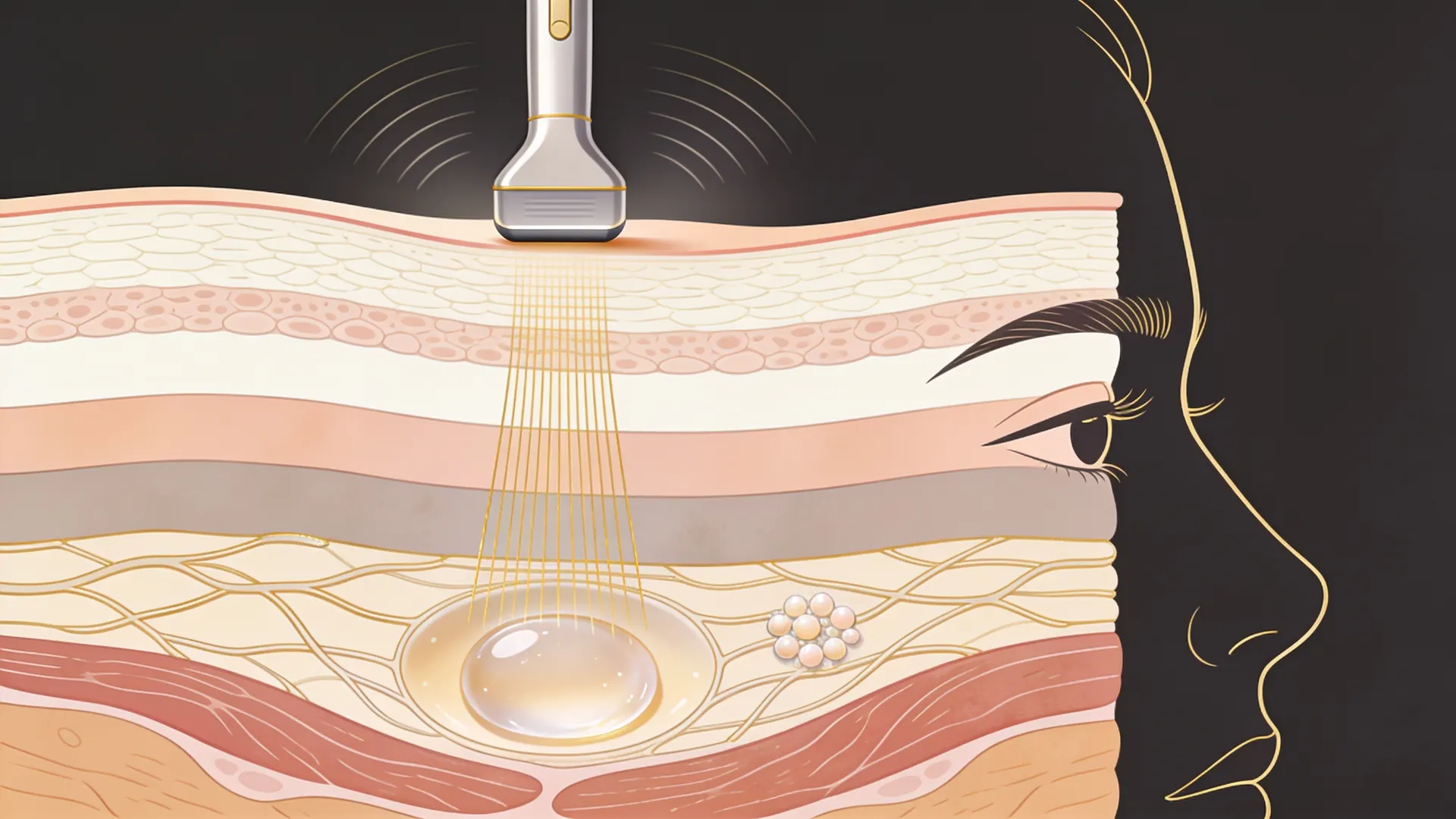
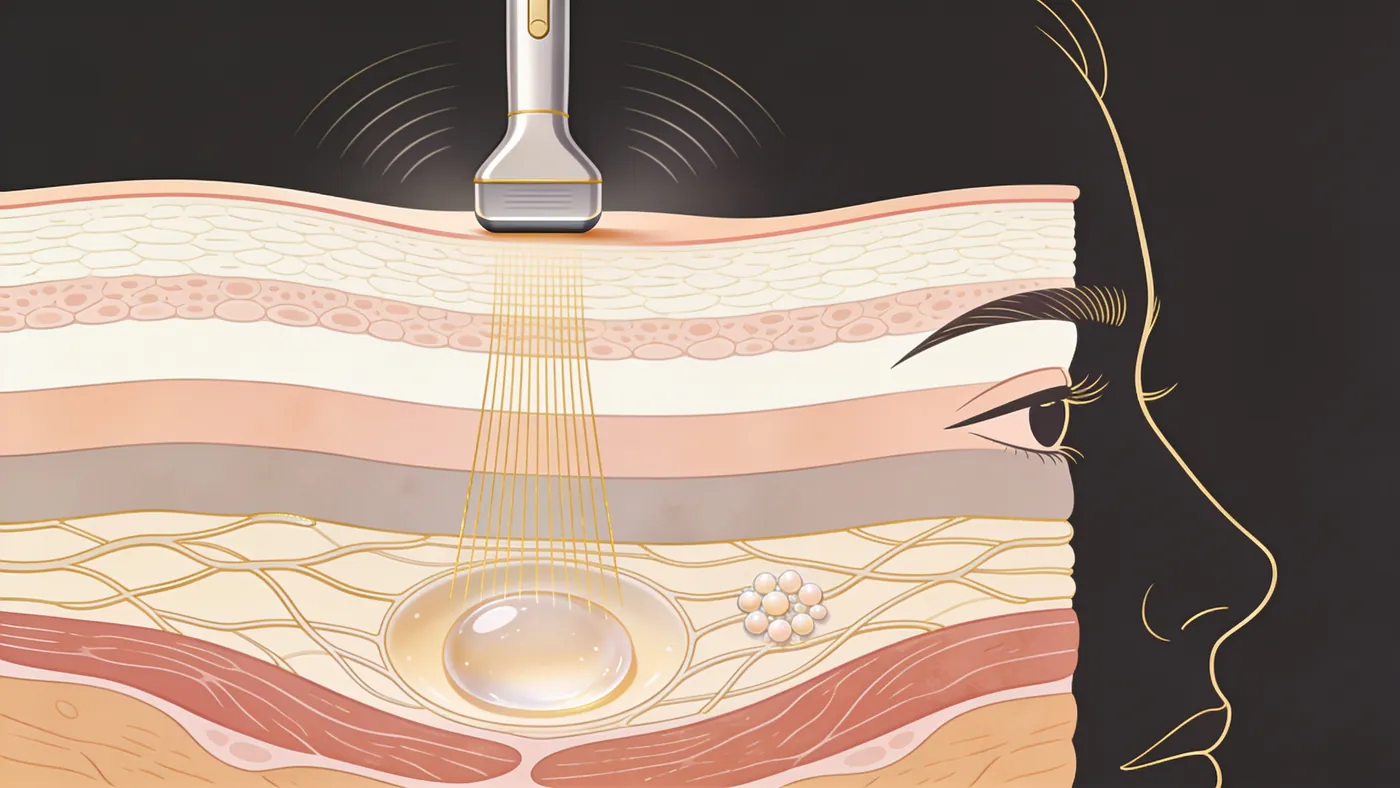
- Ultrasound converges at a set depth to form a thermal coagulation point of roughly 60–70 °C; the surface is spared
- Depths
- 1.5, 2.0, 3.0 and 4.5 mm cartridges for the face; 4.5 mm reaches the SMAS
- Directed at
- Laxity of skin and SMAS, not volume loss, a full fat pad or redundant skin
- Platform used here
- Ultraformer MPT (CLASSYS), with micro-pulsed delivery along each line
What HIFU is, and how it works
HIFU is an energy-based device category rather than a single machine. A handpiece holds a transducer that focuses ultrasound waves, in the way a lens focuses light, so that they converge at one depth beneath the skin. At that focal point tissue is heated to roughly 60–70 °C and coagulates; above and below it the energy is too spread out to cause injury. Each coagulation point sets off a wound-healing response, and over the following weeks and months new collagen is laid down around it.
The depth is set by the cartridge. On the Ultraformer MPT used by Dr Sin Yong, the 4.5 mm cartridge reaches the SMAS, the fascial layer addressed in a surgical facelift; 3.0 mm reaches the dermis and 1.5 mm the superficial dermis. Because the energy is absorbed at depth rather than by melanin in the epidermis, Fitzpatrick III–V skin is treated without the pigment considerations that apply to some light-based devices.
How HIFU is used in aesthetic medicine
HIFU is directed at laxity: skin and SMAS that have loosened along the jawline, under the chin and across the neck, in a face whose underlying fat is neither markedly excessive nor depleted. The brow and forehead are treated with the shallower cartridges, avoiding the orbital rim. The number of lines is an output of the plan rather than a target; it follows the area, the thickness of tissue in each zone and the degree of laxity found at assessment.
The change is gradual. Some people feel the skin is firmer soon after treatment, but that early sensation is not the remodelling itself, which is why review is timed some weeks later. The full account of how HIFU treatment in Singapore is planned, including who it suits and the risks to know, is on the main HIFU page.
“HIFU is an umbrella term. The devices differ in transducer design, imaging and clearance; they are not interchangeable.”
Dr Sin YongOn what HIFU actually denotes
What HIFU is often confused with
Ultherapy is one branded micro-focused ultrasound system (MFU-V) with built-in DeepSEE imaging; HIFU is the wider category that also includes Korean platforms such as Ultraformer, Shurink and Doublo. They share the principle of focal heating at depth but differ in transducer design, imaging and regulatory clearance, so they are not interchangeable. Labels such as 4D HIFU and 7D HIFU are manufacturer marketing terms, not recognised generations of the technology.
Radiofrequency is a different mechanism. Thermage and Volnewmer heat the dermis and subcutaneous layer volumetrically with monopolar radiofrequency rather than at a focal point; Dr Sin Yong's VF Lift – Vertical Facelift runs on Volnewmer and does not use focused ultrasound. The two energies answer different questions, which is why HIFU vs radiofrequency is the wrong comparison to start from. Home HIFU devices operate at far lower energy and are discussed separately.
When HIFU is not the answer
HIFU does nothing for a hollow. Where sagging is driven by volume loss in the midface or temples, heating the SMAS does not replace what has been lost, and volume support is the honest route. It does not reduce a full submental fat pad, which calls for a different mechanism, and it does not remove redundant skin; marked laxity with a great deal of loose skin is beyond any energy device and is referred to a plastic surgery specialist.
It is also usually deferred in pregnancy, with active infection or inflamed acne in the area, over implants or metal in the field, with recent filler or threads in the treatment plane, and in a very lean face with little tissue above bone, where heat placed over thin areas can leave hollowing. A history of keloid scarring is assessed individually. Which of these applies is decided by examination rather than by the name of the device.