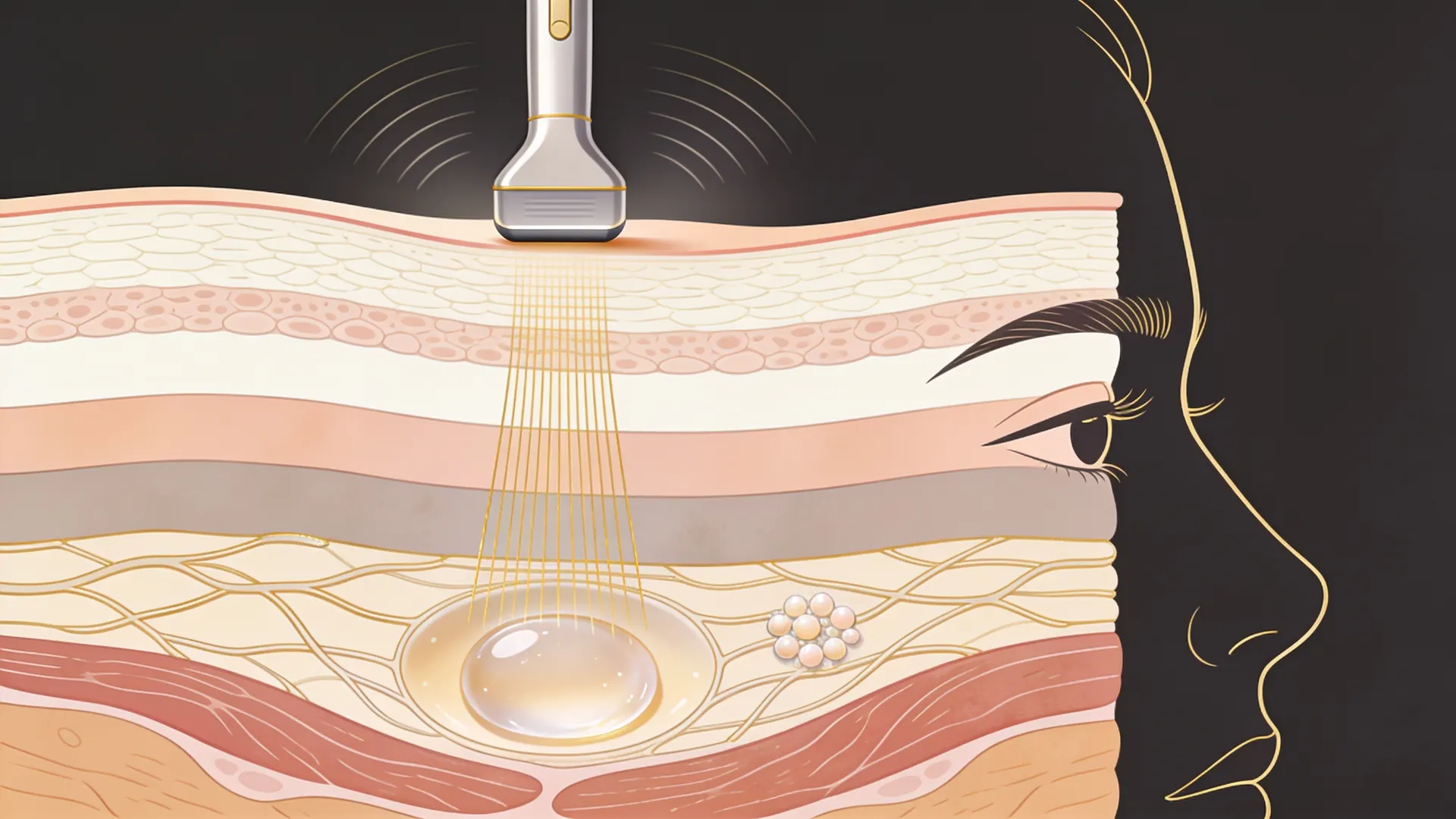
What is HIFU and how does it work?
High-intensity focused ultrasound converges energy at a set depth so a small point of tissue reaches roughly 60–70 °C, forming a coagulation point while the surface stays cool. On Ultraformer MPT, 4.5 mm reaches the SMAS, 3.0 mm the dermis.
Read the full page →What is the difference between HIFU and radiofrequency?
The pattern and depth of heating. Focused ultrasound makes discrete coagulation points at fixed depths down to the SMAS; monopolar radiofrequency passes a 6.78 MHz field through tissue, heating the dermis broadly. Both trigger new collagen, in different layers.
Read the full page →What is the SMAS and why does it matter?
The superficial musculoaponeurotic system is the fibromuscular layer beneath the skin and fat that a surgical facelift tightens. Focused ultrasound at 4.5 mm is designed to reach it; broad dermal heating does not.
Read the full page →Is HIFU the same as Ultherapy?
Not exactly. Ultherapy is one branded micro-focused ultrasound system with built-in imaging; HIFU is the wider category that includes platforms such as Ultraformer. They share focal heating at depth but differ in transducer design, imaging and clearance.
Read the full page →What is the VF Lift?
VF Lift stands for Vertical Facelift: a non-surgical, fully customised protocol on Volnewmer monopolar radiofrequency that addresses laxity, puffiness and hollowing according to each face's anatomy. It is not a one-size treatment.
Read the full page →What is the Time Freeze Laser LCLR®?
Dr Sin Yong's laser-based lifting and skin-quality protocol on a long-pulsed 755 nm and 1064 nm platform, applied to the face and neck and, where suitable, the body. It works by laser heating, not focused ultrasound or radiofrequency.
Read the full page →Is Volnewmer the same as Thermage?
No, though both are monopolar radiofrequency platforms that heat tissue in bulk. Volnewmer is made by CLASSYS and Thermage FLX by Solta Medical, and they differ in handpiece design and delivery. Neither uses focused ultrasound.
Read the full page →Can a thread lift replace a facelift?
No. A thread repositions tissue it can grip; it cannot remove skin. With heavy skin excess, threads produce bunching, and a surgical facelift that excises the excess is the appropriate discussion.
Read the full page →Can HIFU make my face look thinner or hollow?
HIFU is not a fat-reduction treatment, but heat over thin areas of a lean face can leave it looking drawn. Tissue thickness is palpated zone by zone, and sagging driven by volume loss is steered towards volume support instead.
Read the full page →Which layer does each lifting treatment reach?
Focused ultrasound places discrete heat points at set depths, down to the SMAS. Monopolar radiofrequency heats the dermis and subcutaneous layer in bulk. A long-pulsed laser heats the dermis. A cog thread sits in the subcutaneous fat and repositions tissue mechanically. The layer at fault decides the choice.
Read the full page →Do I need lifting or filler for a sagging face?
It depends on whether the problem is descent or volume. A filler adds volume and does not lift; a lift repositions or tightens tissue but does not replace what has been lost. Many faces need both, in the right order, and photographs from earlier years help the examination decide.
Read the full page →What are the three outcomes of the VF Lift – Vertical Facelift?
Lift, reduce and restore. Lifting is directed at laxity, jowling and jawline definition; reducing at excess puffiness such as a heavy lower face; restoring at hollow cheeks, by stimulating collagen and adipose-derived stem cells in the existing fat. Each face is mapped zone by zone.
Read the full page →Who should not have the VF Lift – Vertical Facelift?
Anyone with a pacemaker, defibrillator or other implanted electronic device, because monopolar radiofrequency passes current through tissue. Metal implants near the field change the plan, pregnancy is a reason to wait, and infection or a cold sore in the area is allowed to settle first.
Read the full page →What are the risks of radiofrequency lifting?
Redness, warmth, mild swelling and tenderness are common and short-lived. Less commonly, too much heat in one spot can cause a blister, crust or small burn, a patch of altered sensation, or a slight dent where fat beneath thin skin is over-heated. In darker skin, surface injury can be followed by pigment change.
Read the full page →What does LCLR stand for in Time Freeze Laser LCLR®?
Laser Collagen Lipo Remodelling. The name describes two actions on a long-pulsed 755 nm and 1064 nm platform: collagen remodelling, which produces the lifting and tightening, and lipo-remodelling, in which controlled heating reduces and reshapes compact fat along the jowl and under the chin.
Read the full page →Can I have Time Freeze Laser LCLR® on tanned skin?
No. The 755 nm wavelength is absorbed by melanin, so freshly tanned or sunburnt skin is not treated because the risk of burns and pigment change rises. Photosensitising medicines, recent isotretinoin, a history of cold sores and tattoos within the zone are discussed beforehand.
Read the full page →Can a laser treat an overfilled face or Sculptra nodules?
There is no dissolving enzyme for collagen stimulators such as Sculptra or Ellansé, so excess has to be remodelled rather than dissolved. Time Freeze Laser LCLR® is built to target that excess and take it away, after ultrasound mapping of each deposit. Not every laser can do this.
Read the full page →Can I have HIFU if I already have filler or threads?
Often, but it is assessed individually. Focused ultrasound heats tissue at set depths, so the type, position and timing of any filler or thread in the treatment plane matter. Dr Sin Yong reviews what has been placed, adjusts cartridge depth or avoids those areas, and sometimes defers.
Read the full page →Can HIFU damage the nerves in my face?
Heat landing near a nerve branch, usually along the jaw or above the brow, can cause temporary numbness, tingling or weakness of a facial muscle. The course of the marginal mandibular nerve, the thyroid and the orbital rim are avoided, and any change in facial movement is reviewed promptly.
Read the full page →How many HIFU shots do I need?
There is no correct number. The line count is an output of the plan: the area treated, tissue thickness in each zone, which cartridge depths are appropriate and how much laxity is found. Counts do not compare between devices, and more lines where they are not indicated add heat without benefit.
Read the full page →Do home HIFU devices work like clinic HIFU?
No. Clinic platforms use cartridges at defined depths, down to the SMAS, with energy set by a doctor after examination. Home devices rarely state depth or energy, and some sold as HIFU use radiofrequency, microcurrent or light instead. Use around the eyelids is not advised.
Read the full page →What is the difference between mono threads and cog threads?
A mono thread is smooth, carries no vector and is placed to leave a line of collagen along its track: support for the surface, not a lift. A cog thread has barbs that engage fat and fibrous septae, so tension towards the anchor carries tissue with it. Every lift is a cog-thread lift.
Read the full page →Where are lifting threads placed in the face?
In the subcutaneous fat: beneath the dermis, so they are not seen or felt, and above the SMAS, so they stay superficial to the facial nerve branches and parotid duct beneath it. The SMAS itself is not moved; moving it is surgery, and that is the line between a thread lift and a facelift.
Read the full page →Who is not suited to a thread lift?
Threads suit less well where skin is very thin, because a cog can show or dimple; where laxity is established, because the excess simply redistributes; where the face is heavy with fat, because a thread under tension tends to cut through; and where volume loss rather than descent makes the fold.
Read the full page →Can a thread lift be removed if I dislike it?
Not on demand. Unlike hyaluronic acid filler, a thread cannot be dissolved; it resorbs on its own timeline. An intact thread that shows or has migrated can sometimes be removed physically in the early period, which is one reason vectors are planned carefully. HIFU leaves nothing to remove.
Read the full page →Can a thread lift be combined with HIFU or radiofrequency?
Sometimes. Where descent and laxity coexist, threads are often staged with an energy-based treatment, and the order and spacing are decided at consultation rather than added on the day. Recent threads in the same plane also affect whether HIFU can go ahead, so declare what has been placed.
Read the full page →Is Thermage suitable for darker Asian skin?
Radiofrequency heats tissue through electrical resistance rather than absorption by melanin, so skin colour is less of a factor than with many lasers, and Fitzpatrick III to V skin is routinely assessed for it. Suitability depends more on the degree of laxity, facial volume, pregnancy and implanted devices.
Read the full page →Is 7D HIFU better than 4D HIFU?
The numbers are not a scale. 4D and 7D are marketing labels for features such as cartridge depths, delivery patterns or handpieces, and they are not standardised between manufacturers. What differs between devices is depth, frequency, delivery, imaging and regulatory clearance, decided at assessment.
Read the full page →Can non-surgical lifting help droopy eyelids?
For lax upper-lid skin and brow heaviness, periorbital laser heating with conservative settings can tighten the fine collagen of the eyelid skin. True ptosis of the eyelid muscle and large skin excess are different problems and are referred to an oculoplastic or plastic surgery specialist.
Read the full page →