Conditions · Body · Pigment & Texture

Dark Underarms (Axillary Hyperpigmentation)

Medically reviewed by Dr Sin Yong · Last reviewed 7 October 2026 · 9 min read · Assessed personally by Dr Sin Yong · Jump to questions

Dark underarms are not a hygiene problem — they are pigment, laid down by years of shaving trauma, friction, and irritation from products, on skin that answers every insult with melanin. Occasionally the darkening is velvety and thickened, and then it is a metabolic flag worth a doctor's eye rather than a whitening product.

WhatsApp Dr Sin Yong →
Invited by Device Makers to Share His Expertise
International KOL for 14+ device brandsShared his clinical expertise with 500+ doctors across AsiaMBBS (NUS) · MRCS (Edinburgh) · MSc with Distinction (Queen Mary, London) · MSc (Cardiff)Every assessment personally by Dr Sin Yong

Dark underarms are usually post-inflammatory pigmentation from repeated shaving or plucking, friction and irritant deodorants, sometimes with a grey shadow from hair beneath the skin. Velvety, thickened darkening is different: acanthosis nigricans can signal insulin resistance and warrants a medical check. Assessment separates these causes before topical agents, laser hair removal or laser lightening are chosen.

Key takeaways
  • Dark underarms are usually post-inflammatory pigment from repeated shaving or plucking, friction and irritant deodorant, not poor hygiene.
  • Coarse hair beneath the skin can add a grey shadow that looks like pigment, even on light skin.
  • Velvety, thickened darkening is acanthosis nigricans, which can signal insulin resistance and needs a medical check first.
  • Plans combine stopping the irritation, supervised topical agents, laser hair removal and, where needed, conservative pigment laser.
  • Scrubbing, folk remedies and unregulated bleaching creams do not address the cause and can add irritation.

Key Facts

The main authors
Repeated shaving/plucking trauma, skin-on-skin and clothing friction, irritant deodorant reactions — all driving post-inflammatory pigment
The histology
Studies of darkened axillary skin show pigment changes consistent with chronic low-grade irritation
The shadow component
Coarse residual hair beneath the surface reads as grey shadow even on light skin
The metabolic flag
Velvety, thickened darkening (acanthosis nigricans) associates with insulin resistance — a medical check, not a cosmetic one
Evidence-backed lightening
Topical pigment agents and laser-based approaches, per the systematic review literature
The upstream fix
Laser hair removal retires the razor — removing the pigment driver and the shadow at once
Who assesses this
A physician — velvety thickened darkening gets a metabolic check first
Typical first step
Stopping the friction and shaving trauma; laser hair removal retires the razor

What do dark underarms look like?
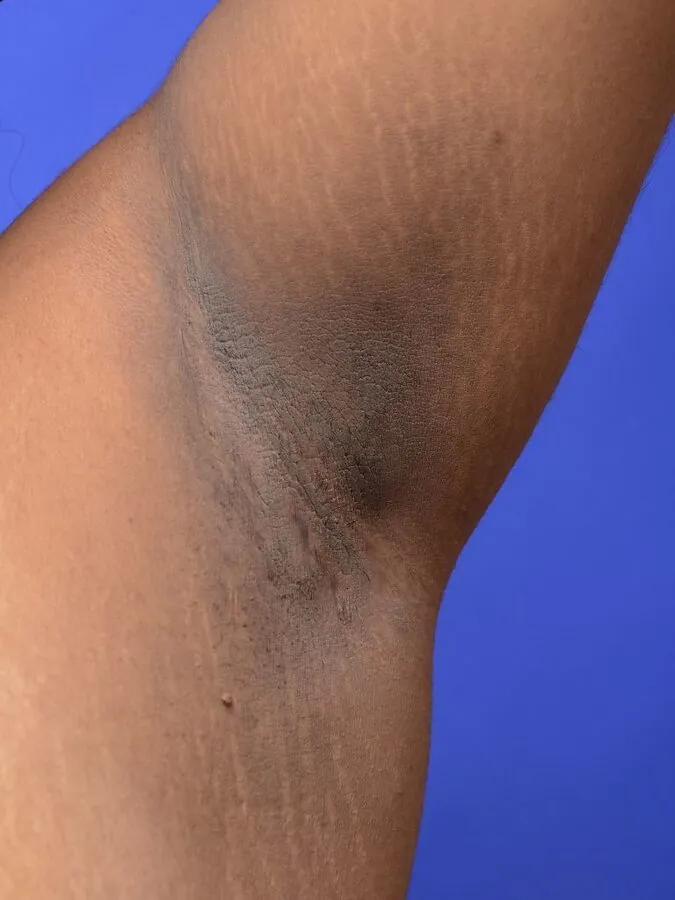
Axillary darkening with skin thickening (acanthosis nigricans pattern)
Axillary darkening with skin thickening (acanthosis nigricans pattern). Image: Mark F. Brady; Prashanth Rawla., via Wikimedia Commons (CC BY-SA 4.0).
Acanthosis nigricans darkening over the upper back, thigh and arm folds
Acanthosis nigricans darkening over the upper back, thigh and arm folds. Image: Ji C et al., Frontiers in endocrinology (2026), via PubMed Central (CC BY).

Why do underarms darken?

The axilla is a perfect storm for post-inflammatory pigment: a fold where skin rubs skin all day, shaved or plucked thousands of times over the years, coated daily in products that low-grade irritate some users — on body sites where melanocytes respond briskly to every insult. Histological work on darkened axillary skin supports this chronic-irritation picture [2]. Two impostors join in: the grey shadow of coarse hair sitting beneath just-shaved skin, and — importantly — acanthosis nigricans, a velvety thickened darkening associated with insulin resistance that is a metabolic sign, not a cosmetic stain.

The one version that needs a doctor first

Run a finger across the darkening. Flat, smooth discolouration on normal-textured skin is cosmetic pigment. A velvety, thickened, slightly ridged surface — often with similar patches at the neck folds — suggests acanthosis nigricans, which the medical literature ties to insulin resistance and metabolic syndrome (the same conversation as multiple skin tags, its frequent companion). That version gets simple blood work and a metabolic conversation before any lightening plan — treating the marker while ignoring the message helps no one.

What actually works for dark underarms?

The systematic review of axillary hyperpigmentation treatment supports a combination logic [1]: stop the insults (switch to non-irritating antiperspirant formulations, loosen chronic friction where possible), lighten the pigment (evidence-based topicals — azelaic, retinoid and related agents — under supervision), and use conservative pigment-laser protocols where topicals plateau, with the same restraint rules as any PIH in darker skin. A high-leverage upstream move: laser hair removal, which retires the razor that has been re-injuring the fold for decades and deletes the sub-surface hair shadow in the same course. The whole-axilla picture — sweat, odour, texture, tags — is assessed together in the underarm programme, alongside hyperhidrosis where sweating rides along.

What doesn't work for dark underarms?

Scrubbing — the pigment is not dirt, and friction is a cause, not a cure. 'Whitening' deodorants — mild actives over a continuing irritation cycle. Lemon and baking-soda folk remedies — irritants applied to irritation-pigmented skin, with predictable results. Bleaching creams from unregulated sources — unsupervised strong agents in a friction fold invite damage. And treating acanthosis nigricans cosmetically while skipping the metabolic check — the darkening is the least important thing that patch is telling you.

“Dark underarms are a diary of every shave and every friction day for a decade — soap can't erase a diary, and scrubbing just adds entries.”

— Dr Sin Yong

Dr Sin Yong’s Viewpoint

Dark underarms are a diary of a decade of shaving and friction, not a hygiene failure — and scrubbing just adds entries. My highest-leverage move is usually retiring the razor with laser hair removal, then treating the leftover pigment. And the velvety, thickened version gets a blood test before any cosmetic plan; that patch may be saying something about metabolism.

Prefer Not to Use WhatsApp?

Use the short enquiry form instead →

Leave your name, mobile number and email and the clinic will contact you directly. No obligation.

Your details are delivered directly to Dr Sin Yong's clinic team.

Thank you — your enquiry has been received. The clinic will contact you during opening hours (Mon–Fri 10am–8pm, Sat 11am–3pm).

Prefer a preliminary view first? You can also WhatsApp a photo of the area for Dr Sin Yong to review before you decide on a visit.

Which type do you have?

Common causes and look-alikes of dark underarms
Type / look-alikeHow to recognise itWhat it needsWhat does not work
Post-inflammatory pigment (shaving, friction)Flat, smooth darkening on normal-textured skin; history of shaving or frictionStopping the irritation, then supervised topical or laser lighteningScrubbing, lemon and baking-soda remedies
Hair shadow beneath the skinGrey tinge beneath freshly shaved skin, even on light skinReducing the sub-surface hair, for example with laser hair removalWhitening deodorants and more shaving
Acanthosis nigricans (velvety type)Velvety, thickened, slightly ridged skin, often also at neck foldsMedical check and blood work before any cosmetic planTreating it as a cosmetic stain only
Irritant deodorant or product reactionDarkening with itch or redness after a new deodorant or productSwitching to a gentler formulation and calming the skinContinuing the product or adding stronger actives

What does not work, and why

When to see a doctor

Myths we hear in clinic

“Dark underarms mean poor hygiene.”

The darkening is post-inflammatory pigment from shaving, friction and product irritation, and washing harder tends to make it worse.

“Home remedies such as lemon or baking soda lighten underarms safely.”

They are irritants, and irritation is what drives the pigment in the first place.

Questions Patients Actually Ask

Are dark underarms caused by poor hygiene?+

No — the darkening is post-inflammatory pigment from shaving, friction and product irritation. It neither smells nor signifies uncleanliness, and washing harder makes it worse.

Why did mine darken even though I stopped shaving?+

Established pigment persists after its cause retires — and plucking, waxing, friction or product reactions may still be running. Assessment sorts the still-active drivers from the leftover pigment.

Does laser hair removal lighten underarms?+

Often visibly — it removes the grey shadow of sub-surface hair and retires the repeated shaving trauma driving new pigment. Remaining stain then gets targeted directly.

What is the velvety thickened type?+

Acanthosis nigricans — associated with insulin resistance and metabolic factors. It earns simple blood work before any cosmetic plan; management of the metabolic side is part of its treatment.

How long does lightening take?+

Months, honestly — pigment leaves the axilla on the same slow schedule as any post-inflammatory pigment, with maintenance of the anti-irritation habits protecting the result.

Can I keep using deodorant during treatment?+

Usually yes, with formulation switched to a gentler option if irritation is contributing — the plan specifies rather than bans.

What causes dark underarms?+
Most often post-inflammatory pigment: repeated shaving or plucking, skin rubbing on skin and clothing, and irritant deodorants prompt the melanocytes to produce extra pigment. Coarse hair under the skin can add a grey shadow. Velvety, thickened darkening can instead be acanthosis nigricans, which is linked to insulin resistance and needs medical assessment.
Can dark underarms be fully removed or cured?+
Pigment can often be lightened, but a complete result cannot be promised. How far it lightens depends on the cause, how long the pigment has been present, whether the irritation has stopped and skin tone. Maintaining gentle habits matters because new pigment can form if shaving, friction or irritation continue.
Which treatment suits dark underarms?+
It depends on the type. Flat post-inflammatory pigment may suit stopping the irritation, supervised topical agents and conservative laser. A hair shadow may suit laser hair removal. Velvety, thickened skin needs a metabolic check first. Skin tone, sensitivity, medications and history decide the plan at assessment.
How much does dark underarms treatment cost in Singapore?+
The fee depends on the cause found, the treatments chosen, such as topical agents, laser hair removal or pigment laser, the area and number of passes, and whether they are combined. Dr Sin Yong gives a written quote at consultation, after assessment, which also decides whether treatment is advised at all. No figures are given beforehand.

References

  1. Axillary Hyperpigmentation Treatment: A Systematic Review of the Literature — Journal of Cosmetic Dermatology (PubMed).
  2. Histological Evaluation of Hyperpigmentation on Female Filipino Axillary Skin — International Journal of Cosmetic Science (PubMed).

Medically reviewed by Dr Sin Yong, MBBS (NUS), MRCS (Edinburgh) · Last updated 7 September 2026 · Editorial policy

Follow Dr Sin Yong
InstagramTikTokYouTubeThreadsXLinkedInFacebook
Printable patient guide (PDF): Body contouring: what to know — medically reviewed by Dr Sin Yong.
Dr Sin Yong · Every assessment personally performed
WhatsApp Enquiry