What does xanthelasma look like?
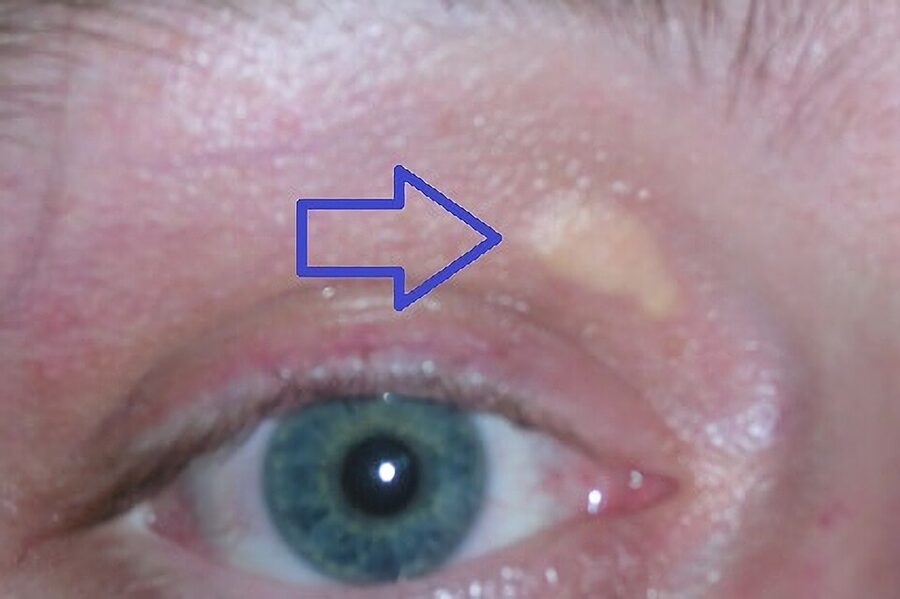
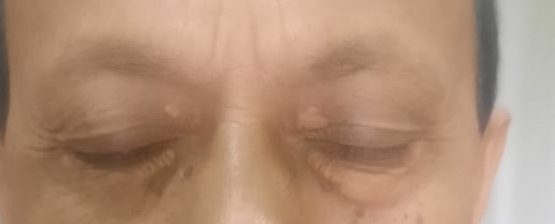
What xanthelasma is
Xanthelasma is the most common cutaneous xanthoma: lipid-filled foam cells settling in the thin skin of the eyelids, forming plaques that creep outward over years [1]. It favours middle age and is more visible in some families than others. It does not threaten vision or health directly — the plaque itself is inert. Its significance is twofold: cosmetic, on the most looked-at anatomy of the face; and metabolic, as a possible flag for lipid abnormalities [1,3].
Does xanthelasma mean high cholesterol?
Roughly half of xanthelasma patients have measurable dyslipidaemia, and the association strengthens when plaques appear young [1,3]. The practical takeaway is simple and cheap: anyone presenting with xanthelasma should have a fasting lipid panel, and where it is abnormal, cardiovascular risk gets assessed properly by their physician. Removing the plaque without asking the lipid question treats the paint and ignores the engine light. Dr Sin Yong raises it in every xanthelasma consult — it is one blood test, and occasionally it is the most valuable thing the appointment produces.
What actually works — and the recurrence truth
Established plaques do not dissolve; removal is physical. The contemporary literature supports ablative CO2 and erbium laser as leading options for most plaques — precise depth control on eyelid skin is the whole game — alongside surgical excision for larger or deeper lesions and other agents in selected cases [2]. On the DEKA CO2 platform (Centre of Excellence), ablation is fractional-precise and staged where plaques are extensive. The honesty clause: recurrence is a documented feature of xanthelasma across every modality — reported in a sizeable fraction of patients over the following years, particularly with untreated lipid abnormalities [1,2]. Managing cholesterol and expectations is part of the treatment plan, not an afterthought. Adjacent eyelid concerns — lid heaviness and dark circles — are assessed in the same sitting when relevant.
What doesn't work for xanthelasma?
Creams, oils and “xanthelasma removal” serums — lipid-laden cells in the dermis are beyond every topical. Home acid kits on eyelid skin — millimetres from the eye, this is scar-and-ectropion territory, and case reports exist to prove it. Squeezing — there is nothing to express. And treating the plaque while ignoring an abnormal lipid panel — the recurrence statistics are written largely by untreated cholesterol.
“Xanthelasma is the rare cosmetic complaint that comes with a blood test attached — remove the plaque by all means, but ask the cholesterol question first.”
— Dr Sin Yong
Dr Sin Yong’s Viewpoint
Xanthelasma is the rare cosmetic complaint where I insist on a blood test before the treatment plan. Half of these patients have lipid abnormalities, and removing the plaque while ignoring the cholesterol is treating the paint and ignoring the engine light. Ask the lipid question first — occasionally it is the most valuable thing the consult produces.
Prefer Not to Use WhatsApp?
Use the short enquiry form instead →
Leave your name, mobile number and email and the clinic will contact you directly. No obligation.
Prefer a preliminary view first? You can also WhatsApp a photo of the area for Dr Sin Yong to review before you decide on a visit.