Filler correction Singapore — assessment before treatment, Dr Sin Yong
Filler Correction Singapore · Dissolving & Removal · Migration & Overfill · Ellanse & Sculptra Correction · Dr Sin Yong

Filler Correction Singapore — Overfilled? Correction Without More Filler

Medically reviewed by Dr Sin Yong · Last reviewed 7 October 2026 · 31 min read · Doctor-performed, never delegated · Jump to questions

Dr Sin Yong · MBBS (NUS) · MRCS (Edin) · MSc Aesthetic Medicine with Distinction (Queen Mary, London) · MSc Practical Dermatology (Cardiff) · International KOL

Sometimes the right step is dissolving. Sometimes it is waiting. It is rarely more product. An assessment-first consultation for filler that feels heavy, puffy, migrated, lumpy — or simply too much. Hyaluronic acid filler can be dissolved in a targeted way with hyaluronidase; Ellanse, Sculptra and other non-HA fillers cannot be dissolved, and are given honest management options instead.

Hyaluronidase
HA Filler Dissolving
Ultrasound
Filler Mapping
Assessment
Before Any Treatment
Honest
Non-HA Options Explained
Invited by Device Makers to Share His Expertise
International KOL for 14+ device brandsShared his clinical expertise with 500+ doctors across AsiaMBBS (NUS) · MRCS (Edinburgh) · MSc with Distinction (Queen Mary, London) · MSc (Cardiff)Every treatment personally performed — never delegated

Filler correction in Singapore is the assessment and management of filler that looks heavy, puffy, lumpy or has moved. Hyaluronic acid filler can be dissolved in a targeted way with hyaluronidase, often after ultrasound mapping; Sculptra, Ellansé and Radiesse cannot be dissolved and are managed case by case. Sometimes the right answer is simply to wait.

Key takeaways
  • Filler correction assesses filler that looks heavy, puffy, lumpy or has moved; adding more filler is one option among several.
  • Hyaluronic acid filler can be dissolved in a targeted way with hyaluronidase, often after ultrasound mapping.
  • Sculptra, Ellansé and Radiesse cannot be dissolved with hyaluronidase and are managed case by case.
  • Sometimes the right decision is to wait, or that nothing needs to be done.
  • Sudden blanching or worsening pain after filler is time-critical and needs same-day medical assessment.

60-Second Filler Self-Assessment

Answer three questions and send them straight to Dr Sin Yong on WhatsApp — he will tell you whether an ultrasound assessment is worthwhile. No obligation, no hard sell.

1 · When was your filler done?
2 · What bothers you most?
3 · Have you had filler dissolved before?

Your answers open in your own WhatsApp app — nothing is stored on this page.

The Problem

You May Have Been Told You Need More Filler

If you have already seen one or two clinics about this, you have probably heard the same suggestion: add filler somewhere else to balance it out, or to camouflage it. Sometimes that advice is reasonable. Often it is not what you want. You came in feeling there is too much in your face — and left with a plan to put in more.

The Approach

“Nobody wakes up overfilled. It arrives one reasonable appointment at a time.”

Dr Sin YongOn how overfilling builds up · from his Instagram explainer series

The Filler Is Assessed — Not Your Face

This consultation starts from a different position. The filler is the thing being assessed. Adding volume is one option among several, and it is frequently the wrong one for overfilled, pillow-face, heavy or migrated filler. Filler removal, partial dissolving, or simply time are all legitimate outcomes. So is being told that nothing needs to be done. No treatment is decided before the assessment is complete.

What We Look At First

A Working Assessment, Not a Sales Conversation

Your filler history, as far as you know it — which products, which areas, roughly when. Bring records or receipts from previous clinics if you have them; if you do not, the assessment still proceeds. The face is examined at rest and in animation, and the tissue is palpated for depth, firmness and edges. Ultrasound can be used to map where the product actually sits before any dissolving decision, so treatment is directed at the filler rather than guessed at.

Not everything that feels heavy after filler is filler. Fluid retention, weight change, natural ageing and the way older HA product holds water can all contribute. Part of the assessment is separating what is product from what is you — because dissolving cannot fix what is not filler.

What Filler Correction Addresses

Overfilled & Heavy Look

Too much volume overall, or volume in the wrong plane — the puffy, rounded ‘pillow face’ pattern that blunts your natural contours. Selective dissolving lets the excess go down rather than layering more on top.

Filler Migration

Filler does not always stay where it was placed. It can spread beyond the treated area or sit more superficially than intended. Migrated hyaluronic acid can be mapped and dissolved in a targeted way.

Lumps & Hard Nodules

A hard lump after filler in the first weeks is usually product or swelling. A firm nodule appearing months or years later can be an inflammatory reaction such as a biofilm or granuloma — that needs examination, not massage or guesswork.

The Tyndall Effect

A bluish tint under thin skin — most often after tear trough filler — from hyaluronic acid sitting too superficially and scattering light. Because it is HA, targeted dissolving treats the misplaced product and the tint goes with it.

Ellanse & Sculptra Correction

Ellanse is polycaprolactone (PCL); Sculptra is poly-L-lactic acid (PLLA). Hyaluronidase does not dissolve either. Lumps and nodules from these fillers have management options, decided case by case on examination — never a promise to ‘dissolve’ them.

Puffiness & Water Retention

Some older HA fillers hold water and read as puffiness rather than volume — worse in the mornings or after salty food. The assessment separates water-holding product from swelling and from your own tissue.

Three Honest Paths

Dissolve, Manage, or Wait

Dissolving — for HA Filler

Hyaluronic acid fillers (Juvederm, Restylane and similar) can be broken down with hyaluronidase. This can be done in a targeted way — treating the migrated or excess portion rather than stripping everything — and conservatively, reassessing between steps rather than over-correcting in one sitting.

Non-HA Fillers — Managed, Not Dissolved

Ellanse, Sculptra and other collagen stimulators do not respond to hyaluronidase — a clinic offering to ‘dissolve’ these is describing something that does not work. These products biodegrade on their own timelines, and nodules have management options that depend on what is found on examination. For older non-degradable fillers, removal is a more involved conversation — and an honest one.

Doing Nothing Yet

Sometimes waiting is the correct clinical decision, not a brush-off. Recently injected filler can look worse in its first weeks than it will settle to. Dissolving too early can mean treating a picture that was about to change on its own. If time is likely to help, you will be told so, with a timeframe to reassess.

“Hyaluronidase dissolves hyaluronic acid and nothing else. If someone offers to dissolve Ellanse or Sculptra, they are describing something that does not happen.”Dr Sin Yong

Filler Gone Wrong

Warning Signs That Should Not Wait

Most filler regret is cosmetic — too much product, the wrong place, a look that isn’t you. Occasionally it is more than cosmetic, and timing changes the differential.

Blanching & Skin Colour Change

Skin turning white over or near the injected area, or developing a dusky, mottled discolouration, can mean filler is affecting the blood supply — vascular occlusion.

Pain That Is Worsening

Pain that is worsening rather than settling in the hours or days after injection is not a normal settling pattern and should be assessed the same day.

What To Do

These signs are time-critical. Do not wait for a routine appointment — seek same-day medical assessment, whether here or with the clinic that injected you.

The Filler Correction Process

01
History & Examination

A thorough filler history — products, areas, timing — followed by clinical examination at rest and in animation, with palpation for depth, firmness and edges. If you do not know what was injected, or it was done overseas, the assessment proceeds the same way, without a lecture.

02
Ultrasound Mapping

Where useful, ultrasound imaging is used to visualise where the product is sitting and at what depth — separating filler from swelling, water retention and your own tissue before any decision is made.

03
The Honest Decision

Targeted dissolving for hyaluronic acid filler; a case-by-case management plan for Ellanse, Sculptra and other non-HA products; or a recommendation to wait, with a timeframe to reassess. If the right advice is to do nothing, you will be told that too.

04
Review & Refinement

Dissolving is staged conservatively, reassessing between steps rather than over-correcting in one sitting. If genuine volume loss is unmasked once excess product is gone, any replacement is planned by anatomy — see volume restoration — rather than re-creating the same problem.

Know What Was Injected
Do not top up over old filler
until you know what is already there.

Migrated, layered or unknown product is the most common reason corrections go wrong. The assessment maps what was injected, where it now sits and how it is behaving — before anything is added or removed.

What are the honest options — dissolve, manage, or wait?

 Wait & monitorPartial dissolutionFull dissolve & restartCorrect then restore
What it meansSome filler settles or degrades on its ownHyaluronidase only where product misbehavesClearing all accessible filler before rebuildingDissolution followed by staged, conservative restoration
When it fitsMinor, recent, non-progressive issuesLocalised migration or lumpsExtensive migration or unknown productsFaces left deflated or lax after clearance
The watch-outWarning signs should never wait — see aboveUnder-treating a spreading problemNot all filler types dissolveRestoration is the plan's second half, not an upsell

Which route applies is a clinical finding, not a preference — the 60-second self-assessment above is the screen; the consultation is the map.

“Hyaluronidase dissolves hyaluronic acid and nothing else. If someone offers to dissolve Ellanse or Sculptra, they are describing something that does not happen.”

— Dr Sin Yong

Correction work most often involves under eye filler that reads as puffiness — the tear trough and eye bag filler zone — along with migrated lip, nose and chin filler. Each deposit is located first, then treated deliberately.

Dr Sin Yong Recommendations on Filler Correction

The physician mapping your filler is the one manufacturers and conferences put in front of other doctors.

Main-stage lecture — CLASSYS Global Customer Summit, Seoul 2025
Panel with international KOLs — CLASSYS APAC 2026
Conference speaker — SAM Conference 2026, Singapore
Receiving DEKA Centre of Excellence certification — July 2026
Minutes, not weeks

Hyaluronidase begins breaking down hyaluronic acid within minutes of placement; the visible result settles over the following days.

18–24 months+

How long HA filler can persist in tissue — and migrated, cross-linked product can outlast that considerably.

HA only

Hyaluronidase reverses hyaluronic acid fillers only — polycaprolactone (Ellanse) and poly-L-lactic acid (Sculptra) require different management.

References

  1. King M, Convery C, Davies E. This month's guideline: The Use of Hyaluronidase in Aesthetic Practice (v2.4). J Clin Aesthet Dermatol. 2018;11(6):E61-E68. PubMed
  2. DeLorenzi C. Complications of injectable fillers, part I. Aesthet Surg J. 2013;33(4):561-575. PubMed
  3. Murray G, Convery C, Walker L, Davies E. Guideline for the Safe Use of Hyaluronidase in Aesthetic Medicine, Including Modified High-dose Protocol. J Clin Aesthet Dermatol. 2021;14(8):E69-E75. JCAD
  4. Aguilera SB, McCarthy A, Khalifian S, Lorenc ZP, Goldie K, Chernoff WG. The Role of Calcium Hydroxylapatite (Radiesse) as a Regenerative Aesthetic Treatment: A Narrative Review. Aesthet Surg J. 2023;43(10):1063-1090. Oxford Academic
  5. Angelo-Khattar M. Objective Assessment of the Long-Term Volumizing Action of a Polycaprolactone-Based Filler. Clin Cosmet Investig Dermatol. 2022;15:2895-2901. Dove Press
  6. Galderma. Sculptra® FAQs: treatment sessions and duration of results. sculptrausa.com

When patients search “filler gone wrong”

At a glance
Reversible category
Hyaluronic acid is the only filler class that can be dissolved enzymatically, using hyaluronidase
Not reversible
Calcium hydroxylapatite, poly-L-lactic acid and polycaprolactone cannot be dissolved; they are managed as they resorb
Migration
Product displaced from its intended compartment, most often recognised in the tear trough and around the lips
Tyndall effect
A bluish-grey cast where hyaluronic acid sits too superficially and scatters shorter wavelengths
Urgent, not cosmetic
Sudden blanching, disproportionate pain or visual change after any filler is a vascular question and needs same-day assessment
Assessment first
What was placed, in what plane, and how long ago determines whether dissolving is appropriate at all

Tear trough filler gone wrong, lip filler gone wrong and chin filler gone wrong are searched by people who already suspect the answer is not more product. Often it is not. The three present differently: the tear trough tends to show puffiness, a bluish cast or a step at the lid–cheek junction; lips tend to show loss of the vermillion border or product sitting above it; a chin tends to show a shape that does not match the rest of the lower face.

“Being told you need more filler to fix how the last filler looks is how a face ends up over-filled. Sometimes the answer is to take something away, and sometimes it is to wait.”

Dr Sin YongOn filler correction

Whether to dissolve filler is a clinical decision rather than a default. Hyaluronidase works only on hyaluronic acid, it does not discriminate between product and the patient's own hyaluronic acid, and dissolving well-placed product alongside the misplaced can leave a worse starting point. What was used, where it sits and how long it has been there is established first — and where the honest answer is to let it resorb, that is what is recommended.

Filler removal and hyaluronidase in Singapore — by concern

People rarely search for “filler correction”. They search for the thing they can see. These are the concerns most often brought to an assessment, and how each is approached before any filler removal or dissolving is decided.

By concern
Overfilled face
Volume built up over several treatments until the face looks wider, heavier or less like itself. Mapped region by region; correction, if needed, is staged.
Tear trough filler migration
Under eye filler that has settled into a puffy ridge below the lower lid, sometimes with a bluish Tyndall tint. Fluid retention is distinguished from product before hyaluronidase is considered.
Lip filler migration
A soft shelf above the lip border, or lumps away from the injection point. Assessed against the natural lip contour and any scar tissue.
Nose and chin filler migration
Widening of the nasal bridge or a chin that no longer fits the lower face. Product type and depth are identified first.
Too much filler in the cheeks
Mid-face fullness that shows most when smiling. Often connected to the pillow face pattern.
Non-HA fillers
Sculptra, Radiesse and Ellansé are not dissolved by hyaluronidase; the plan is different and is assessed case by case.

Hyaluronidase in Singapore is a medical treatment given by a doctor, and filler dissolving is planned from an examination, not a request. Where it helps, high-frequency ultrasound shows where the product is sitting before anything is injected. For a longer explanation of how filler moves and how it is assessed, read Filler migration: the signs, the causes, and what can be done.

Calcium and collagen injectables: Radiesse, HarmonyCA and Deusaderm

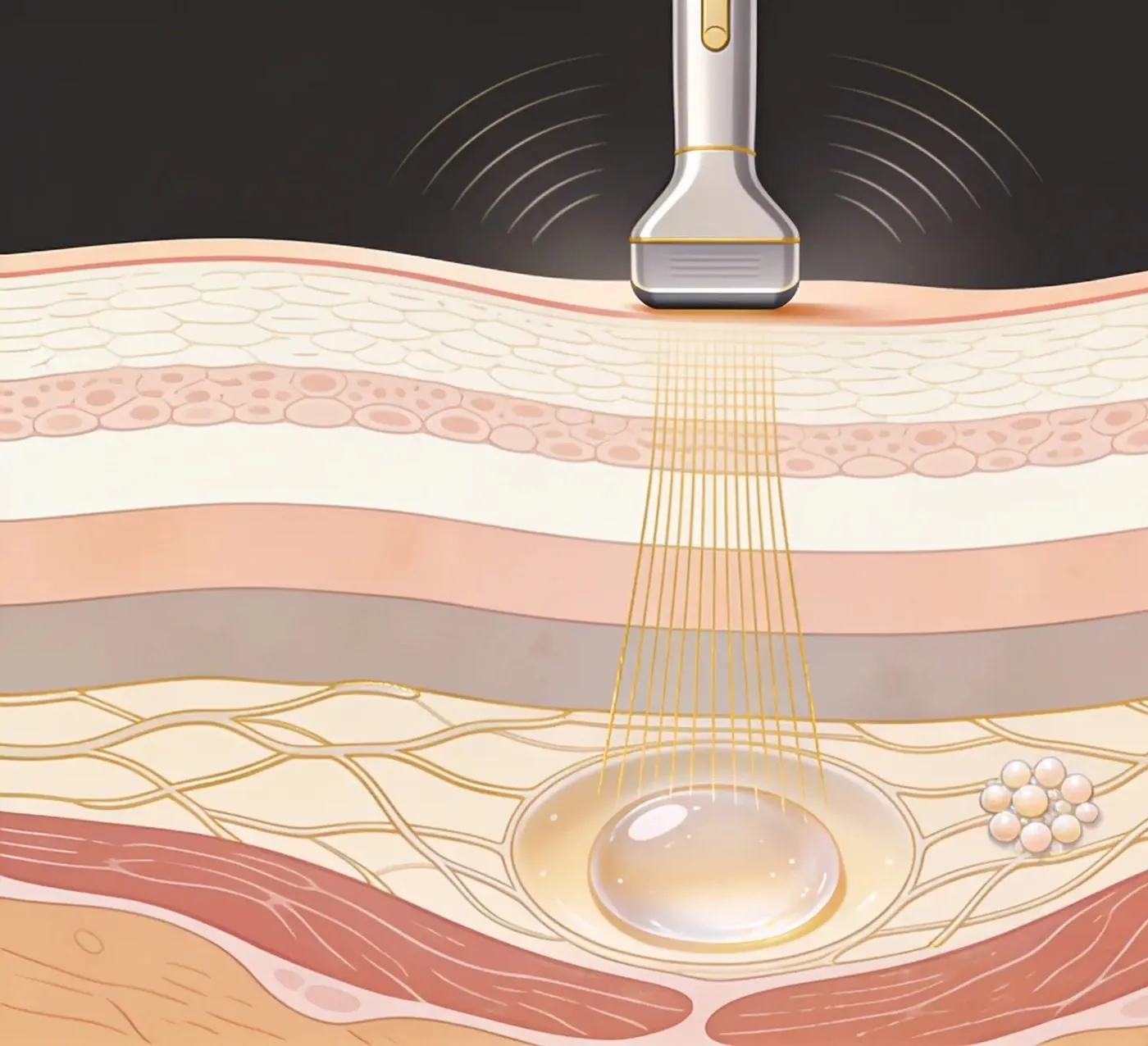
Illustration of facial skin layers in cross-section with an ultrasound probe on the surface, a pocket of gel filler in the deep dermis and a cluster of calcium microspheres in collagen strands
Illustration: hyaluronic acid gel sits as a pocket; calcium and collagen stimulators sit as microspheres in collagen. Ultrasound shows which is present and how deep.

Not every filler is hyaluronic acid. Calcium hydroxylapatite products such as Radiesse and HarmonyCA, and collagen injectables such as Deusaderm, work by stimulating your own collagen over several months. That is also why they cannot be dissolved with hyaluronidase. When a lump, a firm area or an uneven contour appears after one of these treatments, the first step is to find out what is actually there.

The timelines matter when a lump appears. Radiesse is calcium hydroxylapatite (CaHA) carried in a carboxymethylcellulose gel; the review literature describes the gel as cleared from the body within 6 to 8 weeks, while the CaHA microspheres can persist for up to 30 months as collagen forms around them (Aguilera et al., Aesthetic Surgery Journal, 2023). A firm area that shows up at month nine is therefore usually still inside the product’s active life, not a leftover that will soon clear on its own.

“A calcium or collagen filler cannot be dissolved. It can only be assessed and managed.”

— Dr Sin Yong, on non-HA fillers

Dr Sin Yong uses ultrasound to see the material, how deep it sits and whether it has clustered, then discusses the realistic options. These range from leaving it to settle, to targeted injections that soften the area, to other approaches depending on what the scan shows. The same applies to the collagen stimulators Sculptra (PLLA) and Ellansé (PCL): nodules and unevenness after these products are assessed the same way, and the plan is set by what is found rather than by the product name.

These products are slow by design. Sculptra’s manufacturer describes a course of several treatment sessions over a few months, with results described as lasting up to 2 years (Galderma, Sculptra FAQs). For polycaprolactone, a 2022 study in Clinical, Cosmetic and Investigational Dermatology reported PCL-induced type I collagen and elastin fibres present at six months, and microspheres persisting in tissue for over 21 months (Angelo-Khattar, 2022). A nodule from either product is assessed against that timeline, which is one reason ultrasound and a proper history come before any decision.

Swollen or puffy cheeks after filler

Line illustration of a face in profile with several shaded zones over the cheek and under-eye area and a small ultrasound probe resting on the cheek, representing the different causes of puffiness after filler
Illustration: puffiness after filler can come from product depth, product drift, fluid or plain over-volume. Ultrasound separates them before anything is decided.

Cheeks that look heavier, puffier or more swollen than expected, weeks or months after treatment, can have several causes: filler placed too superficially, filler that has drifted, fluid that the filler is holding, or simply more volume than the face needed. Each looks different on ultrasound and each is handled differently.

“Puffiness after filler is not one problem. It is four, and ultrasound tells them apart.”

— Dr Sin Yong, on swollen cheeks after filler

Where hyaluronic acid turns out to be the cause and dissolving is chosen, the UK Complications in Medical Aesthetics Collaborative guideline on hyaluronidase advises reassessing the area after 48 hours and repeating the treatment if necessary, then waiting a minimum of two weeks for swelling to settle before any filler is placed again (Murray et al., J Clin Aesthet Dermatol, 2021). Where the cause is fluid or simple over-volume, hyaluronidase is not the answer and the plan is different.

Dr Sin Yong assesses this at consultation before anything is injected or dissolved. Every consultation is with him personally, at Pacific Plaza on Orchard Road. Message on WhatsApp to arrange a time.

Ellanse vs Sculptra vs Radiesse: how the collagen stimulators differ

Ellansé, Sculptra and Radiesse are often grouped together as collagen stimulators, and people searching “ellanse vs sculptra” or “radiesse vs sculptra” usually want to know one thing: what is actually injected, how long it stays, and what can be done if the result is not what was expected. The three differ in material, in how the collagen response is produced, and in how a concern is managed afterwards. None of them is reversed by hyaluronidase.

 SculptraEllanséRadiesse
MaterialPoly-L-lactic acid (PLLA) microparticles in sterile waterPolycaprolactone (PCL) microspheres in a carboxymethylcellulose gelCalcium hydroxylapatite (CaHA) microspheres in a carboxymethylcellulose gel
How it worksNo immediate volume from the product; the particles trigger a gradual collagen response over monthsThe gel gives some immediate volume; the PCL microspheres then stimulate collagen as the gel is absorbedThe gel gives immediate volume; CaHA microspheres act as a scaffold for new collagen as the gel clears
Course and duration (manufacturer and published data)Typically several sessions over a few months, planned individually at consultation; results described as lasting up to 2 yearsPCL microspheres reported in tissue beyond 21 months, with collagen and elastin fibres present at 6 monthsGel cleared within about 6 to 8 weeks; CaHA reported to persist for up to 30 months
Can it be dissolved?No. Hyaluronidase does not act on PLLANo. Hyaluronidase does not act on PCLNo. Hyaluronidase does not act on CaHA
If there is a concernNodules are assessed with ultrasound and managed according to what is found; the material is still active for monthsLumps or unevenness are mapped with ultrasound; management depends on depth, size and timingUltrasound shows CaHA clearly; options are discussed case by case as the material resorbs

Durations are taken from the manufacturer and the published papers listed in the References section above; they describe the material, not a result in any individual.

Common comparison questions

Both are collagen stimulators that cannot be dissolved, but they are different materials with different behaviour. Sculptra is poly-L-lactic acid given as a course of sessions, with no volume from the product itself on the day; the change comes from the collagen response over months. Ellansé is polycaprolactone in a gel carrier, so there is some volume at the time of injection, and the PCL microspheres have been reported in tissue beyond 21 months. For a concern after either, the assessment is the same: ultrasound to see where the material sits and how deep, then a plan based on what is found.

Radiesse is calcium hydroxylapatite in a gel carrier. The gel gives volume on the day and is cleared within about 6 to 8 weeks; the CaHA microspheres then act as a scaffold for collagen and have been reported to persist for up to 30 months. Sculptra has no gel-carrier volume and works purely through the collagen response to PLLA over a course of sessions. Neither responds to hyaluronidase. Because CaHA is highly visible on ultrasound, a Radiesse-related lump is usually straightforward to locate and map.

The first step is to establish what the lump is, how deep it sits and how long ago the product was placed, because a firm area within the active life of the material is a different situation from an inflammatory nodule appearing later. Dr Sin Yong uses ultrasound to answer those questions at the consultation, and the options, from monitoring to targeted injections, are discussed from that picture rather than from the product name alone.

Watch

Dr Sin Yong explains

If you regret your filler: why going back for more to balance it is a common mistake. A short video from Dr Sin Yong’s Instagram, with captions.

Watch on Instagram: If you regret your filler: why going back for more to balance it is a common mistake.

Planning lip, under-eye, nose or chin filler in Singapore? What to check first

Much of the filler seen for correction traces back to choices made at the start, so the questions worth asking come before the first injection. The first is which product will be used and whether it can be dissolved. Hyaluronic acid can be reversed with hyaluronidase; calcium hydroxylapatite, poly-L-lactic acid and polycaprolactone cannot, which matters most in thin-skinned or higher-risk areas such as the under-eye and the nose.

The second is what the plan is based on. Lip, under-eye, nose, chin and other face fillers each have their own anatomy and risks: the under-eye tends to show product placed too superficially as puffiness or a bluish tint, lips can lose a defined border when product sits above it, and the nose carries vascular risk. A plan built on the face's anatomy, rather than on a number of syringes, is the safeguard against overfilling.

The third is records. Ask for the product name, the areas treated and the date, and keep them; if anything needs reviewing later, knowing what was injected makes the assessment simpler. And if you already have filler, have it assessed before more is added on top. The dedicated guides to lip, under-eye, nose, chin and dermal fillers cover each area in more detail.

Who should not have filler dissolving?

Hyaluronidase is not right for everyone, and some situations call for a different plan rather than dissolving. A known allergy to hyaluronidase, or a history of significant reactions to bee or wasp stings, raises the risk of an allergic reaction, as the UK guideline on hyaluronidase listed in the references discusses, so this is asked about before any elective dissolving. Elective treatment is usually deferred during pregnancy and breastfeeding.

Active infection or inflamed skin over the area is settled first. A lump that is red, warm or tender is examined before anything is injected, because infection and inflammatory nodules are managed differently from simple excess product. Dissolving is also not the answer when the material is not hyaluronic acid, such as Sculptra, Ellansé or Radiesse, or when the fullness is fluid, swelling or your own tissue.

Timing counts too: filler placed in the last few weeks may still be settling. A suspected vascular occlusion is the exception to all of this; it is treated as an emergency, and the balance of risks is judged differently. Suitability is decided at consultation.

Is filler dissolving safe? The risks to know

Dissolving hyaluronic acid filler with hyaluronidase is an established medical treatment, but it has risks of its own. Swelling, redness, tenderness and bruising at the injection points are common and usually settle over days. Itching or local swelling can be an allergic response and, rarely, a more widespread allergic reaction occurs, which is why patients are observed after injection and emergency treatment is kept to hand.

Hyaluronidase does not distinguish filler from the body's own hyaluronic acid, so the area can look temporarily flatter or more hollow than expected, especially where filler was masking volume loss. Too little may leave product behind and need another round; too much in one sitting can over-correct. It has no effect on non-HA fillers or on fat.

These risks are reduced by mapping the product first, with ultrasound where useful, dissolving conservatively in stages and reassessing between rounds. Swelling that worsens, spreading redness or any difficulty breathing after treatment needs prompt medical attention.

What recovery looks like after filler correction

The sequence below describes phases, not a timetable: how quickly each passes depends on the settings used, the area and the person, and is discussed at consultation.

  1. Immediately afterSwelling, redness and tenderness at the injection points; after hyaluronidase, the area can look fuller for a while from the process itself.
  2. The first eveningAvoid pressure, heat and alcohol; patients are observed after injection because itching or local swelling can signal an allergic response.
  3. The following daysSwelling from the dissolving settles and the true contour emerges; bruising fades on its own.
  4. As the skin settlesWhere product was removed, the tissue is reassessed, often with ultrasound, before any decision about replacing volume.
  5. Follow-upAny refilling waits until swelling has resolved and the area is reviewed; worsening swelling, spreading redness or breathing difficulty is urgent.

Who it suits, who should wait, who is referred on

Tends to suit

  • Hyaluronic acid filler that looks overfilled, puffy or has migrated
  • Lumps or a bluish tint under thin skin from superficial filler
  • Wish for the filler itself to be assessed before more is added
  • Records of past filler, or willingness to be assessed without them

Better to wait

  • Filler placed recently that is still settling
  • Pregnancy or breastfeeding
  • Active infection or inflammation at the site

Referred on

  • Suspected vascular occlusion: same-day medical assessment, here or where it was injected
  • Older non-degradable fillers or non-HA nodules: a more involved case-by-case discussion
Who should not have this treatment
  • Known allergy to hyaluronidase, or a history of bee or wasp sting allergy, assessed first
  • Active infection or inflammation at the injection site
  • Pregnancy or breastfeeding
  • Filler that is not hyaluronic acid, because hyaluronidase does not act on it
  • Swelling or heaviness that is not filler, such as fluid retention or weight change
  • Recent filler that is likely to settle by itself

People hoping that Sculptra, Ellansé or Radiesse can be dissolved, or expecting an immediate flat face from one visit, tend to be disappointed, because hyaluronidase acts on hyaluronic acid only.

Before you book

What determines the fee

The fee depends on how many areas need assessment, how much filler is involved and where it sits, whether ultrasound mapping is useful, whether dissolving is staged across visits with reassessment, and whether any replacement is planned afterwards. Non-HA products are managed case by case and are priced after examination. A written quote is given at consultation after assessment. The consultation also decides whether dissolving is advised at all, since waiting or no treatment is sometimes the right answer.

How quotes work at this practice: how we quote.

Myths we hear in clinic

“All filler, including Sculptra and Ellansé, can be dissolved.”

Hyaluronidase dissolves hyaluronic acid only; Sculptra, Ellansé and Radiesse are managed case by case as they biodegrade.

“If filler looks wrong, more filler elsewhere will balance it.”

Adding volume is one option among several and is often the wrong one for overfilled, migrated or heavy filler, so the filler is assessed first.

Frequently Asked Questions — Filler Correction

Sometimes, yes. Depending on what the ultrasound assessment shows, options can include partial rather than complete dissolving, energy-based lifting to improve the surrounding support, or simply monitoring. Dissolving is a tool, not an obligation — the assessment decides.

Dr Sin Yong takes a history of what was injected and when, examines the face, and where indicated maps the filler with ultrasound to see exactly where product sits and whether it has migrated. You leave with a clear picture of what is there and a plan — whether or not that plan involves dissolving anything.

At home, you often can’t — that is normal. Time since injection, how the area feels to touch, and how it changes through the day all give clues, and the examination is designed to separate the two. If it is swelling, treating it as filler would be the wrong move.

No. Ellanse is polycaprolactone, and hyaluronidase — the dissolving enzyme — only works on hyaluronic acid. Ellanse lumps and nodules have management options, discussed case by case after examination, but dissolving is not one of them — and it is important you are not told otherwise.

No. Sculptra is poly-L-lactic acid (PLLA) and does not respond to hyaluronidase. Nodules from Sculptra and other collagen stimulators are managed differently, depending on what is found on examination — which is exactly why the assessment comes first.

Dissolving removes filler; it does not remove your own tissue. If the filler was masking a real volume change, the face underneath will show it — this is why dissolving is done conservatively, and why the assessment maps what is product and what is you before anything is injected. If genuine volume loss is unmasked, any replacement is planned by anatomy — see volume restoration — rather than re-creating the same problem.

There is usually some swelling from the process itself before the true result is visible. The realistic timeline for your case is discussed at assessment, because it depends on the product, the amount and the area.

It helps, but it is not required. Records from your previous clinic are useful if you can get them. If you cannot, the examination and ultrasound mapping still give enough information to plan from.

You will not be lectured about it. It is common, and the assessment is the same: establish what is there now and what the sensible options are from here.

Timing changes the differential. A lump in the first days or weeks after injection is usually product placement or swelling, and often settles. A firm nodule appearing months or years later can be an inflammatory reaction such as a biofilm or granuloma, and needs examination rather than massage. Any lump that is painful, growing, or comes with skin colour changes should be assessed promptly.

Blanching (skin turning white), dusky or mottled discolouration, and pain that is worsening rather than settling can mean filler is affecting the blood supply — vascular occlusion. This is time-critical: seek medical assessment the same day, whether with the clinic that injected you or another doctor.

Yes, if it is still wanted once the face has settled. Swelling from the dissolving itself has to resolve first, and the UK guideline cited on this page advises waiting a minimum of two weeks before filler is placed again. The face often looks different once excess product has gone, and any new plan is made from that picture rather than from the original one.

The under-eye has thin skin, little fat over the bone and a tendency to hold fluid, so filler there shows problems that would stay hidden elsewhere. Gel placed too superficially can show as a bluish tint, product that has drifted can form a puffy ridge below the lower lid, and some hyaluronic acid draws in water and reads as swelling. Because it is usually hyaluronic acid, it can be mapped and dissolved in a targeted way when that is the right decision.

The fee depends on the number of areas, the amount and type of filler involved, whether ultrasound mapping is useful, whether dissolving is staged and whether replacement is planned later. A written quote is given at consultation after assessment, and the consultation also decides whether dissolving is advised at all, or whether waiting is the better choice.

It is worth considering if filler looks heavy, puffy, lumpy or has moved, particularly hyaluronic acid filler that can be dissolved in a targeted way. It is not worth rushing for recent filler still settling, or for puffiness that is not filler at all. Collagen stimulators cannot be dissolved, so correction means case-by-case management.

No duration can be promised. How your face looks afterwards depends on your anatomy, how much product was dissolved, ongoing ageing, weight and any replacement you choose. For non-HA products it depends on how each product biodegrades, which varies between individuals. Review timing is set at consultation after assessment.

Dissolving can cause swelling and bruising, and hyaluronidase cannot tell product from your own hyaluronic acid, so over-dissolving can leave a deflated look. It works only on hyaluronic acid, not Sculptra, Ellansé or Radiesse. Staged visits are often needed, and an allergic reaction is uncommon but possible.

Question not answered here? Ask on WhatsApp, use the enquiry form, or browse 100 questions patients ask.

Medically reviewed by Dr Sin Yong, MBBS (NUS), MRCS (Edinburgh) · Last updated 5 October 2026 · Editorial policy

Patient guide (PDF): After your filler treatment — a printable summary of this page, medically reviewed by Dr Sin Yong. General information, not a substitute for assessment.

Related reading

Filler Correction Consultation — Dr Sin Yong

Start with a message, not an appointment. Describe the concern in a WhatsApp message first — what was done, roughly when, and what feels wrong now. You will get a straightforward reply about whether an assessment makes sense, before you commit to coming in.

  1. 1WhatsApp a short note on your concern
  2. 2Consultation and assessment with Dr Sin Yong
  3. 3Options explained, including no treatment

Replies within clinic hours: Mon–Fri 10am–8pm, Sat 11am–3pm · How consultations work · Prefer not to use WhatsApp? · Treatment finder

WhatsApp +65 8023 7170

This page is general information, not a diagnosis. Signs suggesting vascular compromise — blanching, dusky mottling, worsening pain — need same-day medical assessment.

Explore Further

Prefer Not to Use WhatsApp?

Leave your name, mobile number and email and the clinic will contact you directly. No obligation.

Your details are delivered directly to Dr Sin Yong's clinic team.

Thank you — your enquiry has been received. The clinic will contact you during opening hours (Mon–Fri 10am–8pm, Sat 11am–3pm).
Or continue on WhatsApp instead →
Follow Dr Sin Yong
InstagramTikTokYouTubeThreadsXLinkedInFacebook
Dr Sin Yong · Ask about fillers and correction · Doctor-performed
WhatsApp Enquiry