Medically reviewed by Dr Sin Yong · Last reviewed · 11 min read · Assessed personally by Dr Sin Yong · Jump to questions
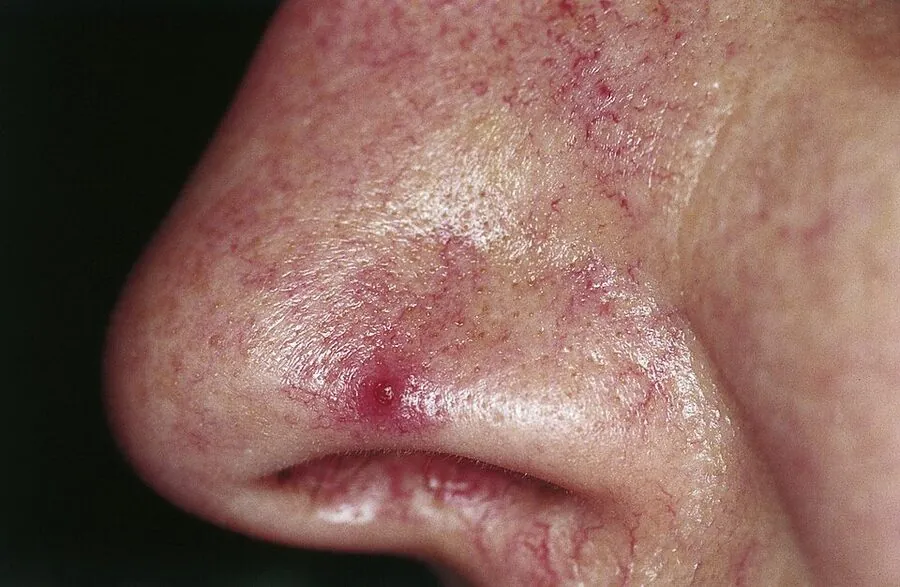
Telangiectasias are permanently dilated small blood vessels visible at the skin surface — fine red, purple or blue threads tracing the nostril creases, cheeks and chin. They are not broken capillaries (nothing is broken) and they do not close on their own: a vessel that has remodelled open stays open until something closes it.
WhatsApp Dr Sin Yong →Facial telangiectasia, or red veins, are small blood vessels that stay dilated at the skin surface, typically around the nostrils, cheeks and chin. They are not broken capillaries. Dr Sin Yong assesses vessel colour, depth and skin type to choose between vascular lasers and IPL.


Vessel walls are collagen-supported. Decades of sun weaken that support; rosacea adds chronic inflammatory dilation; genetics loads the dice; and thin, ageing skin simply hides less. The result is vessels that dilate and never fully recover their calibre — telangiectasia is vascular remodelling, which is why no cream, diet or cold compress reverses it. The reviews of light-based treatment for facial erythema and telangiectasia describe this remodelled state as the target: a fixed structure that must be physically closed [1].
Three related but different problems share the red face. Fixed visible threads are telangiectasia. Episodic waves of heat and colour are flushing. Persistent background redness with sensitivity, papules or flushing episodes points to rosacea — of which telangiectasias are often one visible component. The distinction matters because vessel-sealing treats the threads but not the disease driving new ones: rosacea patients who clear their vessels without managing the rosacea are booking a rematch. Assessment sorts this in minutes.
Selective photothermolysis: light of a wavelength absorbed by haemoglobin heats the blood within the vessel, injuring its wall so the body seals and resorbs it. The review literature supports vascular lasers — 532 nm for fine superficial red vessels, long-pulsed 1064 nm for deeper or blue-purple ones — and IPL for diffuse redness, with high clearance of discrete facial telangiectasias across studies [1]. Work in Asian patients specifically supports the longer-wavelength approach, which spares epidermal melanin and lowers pigment complications in Fitzpatrick III–V skin [2]. Vessels may need more than one pass, and new vessels can form over the years if the underlying drivers — sun, rosacea — continue; photoprotection and disease control protect the result. Diffuse post-treatment tone work sits with laser toning and skin-quality programmes like R2 Glow.
Creams for “broken capillaries” — a remodelled vessel has no biochemical off-switch a topical can press. Icing — constriction is temporary by definition. Vitamin K serums — evidence stops at bruising, not established vessels. Home IPL devices — underpowered for vessels and unguided near the eyes. And squeezing or needling threads at home — trauma plus infection risk on the most visible skin you own, for a problem a clinic seals in minutes.
“Nothing is broken in a 'broken capillary' — the vessel remodelled open, and a vessel that remodelled open stays open until it is sealed shut.”
— Dr Sin Yong
'Broken capillaries' is a misnomer I correct daily — nothing is broken; the vessel remodelled open and will stay open until it is sealed. The satisfying part is that sealing works. The physician part is checking whether rosacea is quietly manufacturing new vessels before I clear the current ones.
Use the short enquiry form instead →
Leave your name, mobile number and email and the clinic will contact you directly. No obligation.
Prefer a preliminary view first? You can also WhatsApp a photo of the area for Dr Sin Yong to review before you decide on a visit.
| Type / look-alike | How to recognise it | What it needs | What does not work |
|---|---|---|---|
| Fine telangiectasia (thread veins) | Fixed thread-like red vessels on nostrils, cheeks or chin | Vascular laser or IPL matched to vessel colour and depth | Creams, icing and vitamin K serums |
| Deeper blue-purple vessels under the skin | Larger, bluish vessels sitting deeper in the skin | Longer-wavelength laser chosen for depth | Surface treatments and home IPL devices |
| Flushing (episodic redness and heat) | Episodic waves of heat and colour that fade between episodes | Trigger review and medical assessment | Sealing vessels alone without a review |
| Rosacea (persistent redness with sensitivity) | Persistent redness with sensitivity, bumps or flushing episodes | Medical management of rosacea alongside vessel treatment | Treating threads while ignoring the disease |
Nothing is broken; the vessel has remodelled open, and no cream, diet or cold compress reverses it.
New vessels can form over the years if sun damage or rosacea continue, so protection and disease control are part of the plan.
No — facial telangiectasias are cosmetic. Exceptions worth a doctor's eye: vessels appearing in unusual patterns in childhood or with other symptoms, which belong to different conditions.
The nasal creases combine high vascular density, constant sun exposure and mechanical stress — the perfect address for dilated vessels. They are also the most treatment-responsive site.
Most patients describe brief rubber-band snaps per pulse. Sessions are short and topical anaesthetic is available for sensitive areas.
A properly sealed vessel does not reopen — it is resorbed. New vessels can form over years if sun exposure or rosacea continues, which is why the drivers get managed alongside the threads.
With appropriate wavelength choice — particularly long-pulsed 1064 nm — and conservative settings, vascular laser work is established in Asian skin. Device selection is precisely the physician's job here.
Often, in a sequenced plan — different targets need different wavelengths and sometimes different visits. Mapping both is part of one assessment.
Medically reviewed by Dr Sin Yong, MBBS (NUS), MRCS (Edinburgh) · Last updated 7 October 2026 · Editorial policy
Vbeam is a brand of pulsed-dye laser, and pulsed-dye is one of several vascular laser families that seal facial thread veins by the same principle: light absorbed by haemoglobin heats the vessel until it closes. They differ in wavelength, depth and how they behave in pigmented skin.
Pulsed-dye lasers, at around 585 to 595 nm, are strongly absorbed by oxygenated blood and are well studied for fine red vessels and diffuse redness; temporary bruising (purpura) can follow at some settings. 532 nm KTP lasers suit fine, superficial red vessels and have been compared with pulsed-dye in split-face studies, but the shorter wavelength is absorbed more by epidermal melanin. Long-pulsed 1064 nm Nd:YAG reaches deeper, suits larger or blue-purple vessels and spares epidermal melanin, which is why it is documented specifically in Asian skin. IPL is filtered broadband light, used more for background redness than for single threads.
No one device suits every vessel: colour, calibre, depth and skin type decide. At this clinic, facial redness and the vascular presentation of rosacea are also addressed with the 675 nm 少女光 protocol on the DEKA RedTouch Pro, and which approach fits is settled at assessment.