Medically reviewed by Dr Sin Yong · Last reviewed · 19 min read · Doctor-performed, never delegated · Jump to questions
Dr Sin Yong · MBBS (NUS) · MRCS (Edin) · MSc Aesthetic Medicine with Distinction (Queen Mary, London) · MSc Practical Dermatology (Cardiff) · International KOL
Many droopy eyelids do not need blepharoplasty at all. If your double eyelid crease is still there and the problem is heavy, hooded skin, energy-based lifting — focused ultrasound and radiofrequency around the brow and eyelid, or precision laser resurfacing of the lid itself — can lift the eye area without a scalpel, without stitches and without changing the eyes you were born with. It starts with an assessment that tells you which category your eyelids are actually in.
A non-surgical eyelid lift raises hooded or heavy upper eyelids without cutting, using focused ultrasound and radiofrequency to lift the brow and periorbital support, and fractional laser to tighten thin lid skin. It suits hooded eyes and brow descent with an intact double eyelid crease; true ptosis, a weak eyelid muscle, is referred for surgery.

“Droopy eyelids” is one complaint with three different anatomies. True ptosis is a weakness of the levator muscle that opens the eye — a medical condition, formally assessed by measurements such as MRD1, and treated surgically when significant. Dermatochalasis is hooded, redundant skin folding over an intact crease. Brow descent drops the entire brow complex onto the lid, making healthy eyelids look heavy. Each looks similar in the mirror; each has a different right answer. That is why every patient here is assessed — crease, levator function, brow position and skin quality — before any treatment is proposed.
Where the crease is intact and the diagnosis is hooding or brow descent — which describes a large share of people searching for droopy eyelid surgery — a non surgical eyelid lift treats the cause without an operation. Monopolar radiofrequency (Volnewmer) lifts and tightens the brow and periorbital support (the VF Periorbital Eyelift), while fractional laser resurfacing tightens the thin lid skin itself. No incisions, no sutures, no general anaesthesia — and your natural double eyelid stays exactly as it is. Where assessment shows true ptosis, the honest answer is different: ptosis correction is surgical, and you will be told so plainly and referred appropriately.
Blepharoplasty cuts skin away and re-forms a crease. But if your crease is intact and the real problem is descent — heavy brow, hooded skin, loose lid support — cutting solves a problem you do not have. Assessment first. Then lift what needs lifting.
The assessment sorts every “droopy eyelid” into one of three anatomies — and the right treatment follows from the category, not the complaint:
Dermatochalasis — loose skin folds over an intact crease. The eye opens normally; the lid just looks heavy. Well suited to non-surgical lifting.
The brow complex has dropped, pushing normal eyelids downward. Lifting the brow with focused energy restores the frame around the eye. Well suited to non-surgical lifting.
The levator muscle that opens the eye is weak — the lid margin itself sits low (MRD1 under about 2 mm). This is surgical territory, and you will be told honestly.
Upper eyelid skin is the thinnest on the body — why eyelid energy work demands precise, conservative settings.
The margin-reflex distance threshold that points to true ptosis — the measurement that separates lifting candidates from surgical ones.
Focal depths of the focused-ultrasound transducers used around the brow and periorbital area — energy placed at chosen depths, not cut.
The dermal temperature band where collagen contracts and remodelling begins — the mechanism of energy-based lid tightening.
CO2 laser wavelength used for fractional resurfacing of hooded lid skin, with protective eye shields in place throughout.
A non surgical eyelid lift involves no cutting, no sutures and no general anaesthesia — and leaves your natural double eyelid crease untouched.
Crease position, levator function, MRD1, brow position and skin quality are examined — the complaint is sorted into its true anatomy.
If your double eyelid crease is intact, surgery is rarely the first answer — lifting is planned around preserving it exactly as it is.
True ptosis is told apart from hooding and brow descent. Surgical cases are told so plainly and referred — not squeezed into a device plan.
Focused ultrasound and radiofrequency lift the brow and periorbital support; fractional laser tightens the lid skin where indicated.
Collagen remodelling builds over the following weeks — the lift develops progressively rather than overnight.
The eye area is reviewed and the maintenance interval agreed — conservatively, because eyelid skin rewards restraint.
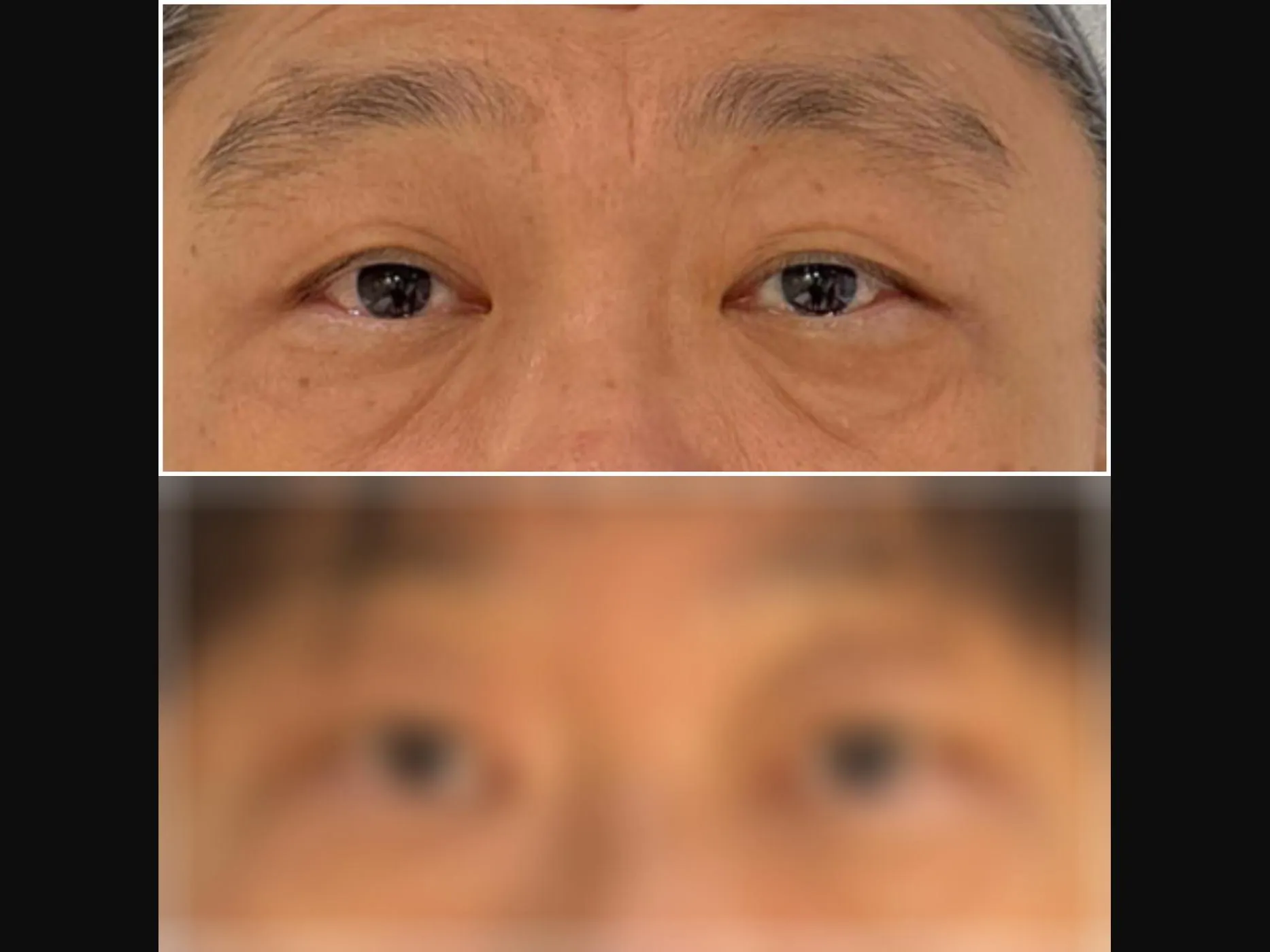
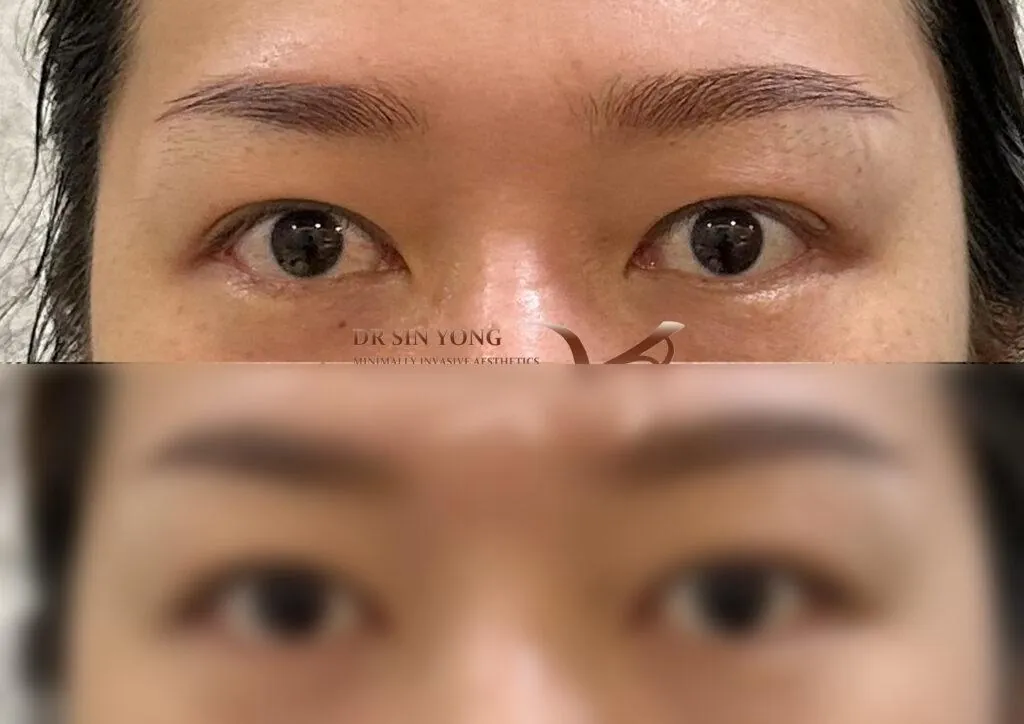
Shown as before-and-blurred composites in line with Singapore advertising guidelines — actual unblurred case photographs can be viewed at the clinic.


Non surgical eyelid lift, laser eye lift, blepharoplasty or ptosis surgery — the assessment decides which column you are actually in. Many patients searching for droopy eyelid surgery discover they belong in the first two.
| VF Periorbital Eyelift | Laser eyelid lift | Upper blepharoplasty | Ptosis surgery | Monitor only | |
|---|---|---|---|---|---|
| What it is | Volnewmer monopolar radiofrequency lifts the brow and periorbital support (no focused ultrasound) | Fractional CO2 laser tightens the hooded lid skin itself | Skin is cut away and the crease re-formed under surgery | The levator muscle is surgically shortened or reattached | The eyelids stay as they are, reviewed over time |
| Well suited for | Hooding and brow descent with an intact crease | Thin, crepey, hooded lid skin | Heavy skin redundancy beyond what energy can lift | True ptosis — a low lid margin from muscle weakness | Mild hooding a patient prefers to monitor |
| Your double eyelid crease | Preserved exactly as it is | Preserved | Re-made surgically — it may not look like yours | Altered as part of surgery | Unchanged |
| Anaesthesia | None or topical | Topical, protective eye shields | Local or sedation | Local or sedation | None |
| Downtime | Varies — discussed at consultation | A few days of redness and micro-crusting | Sutured wounds; typically 1–2 weeks of visible recovery | Sutured wounds; typically 1–2 weeks | None |
| What the assessment decides | Confirms crease intact and descent-type droop | Confirms skin-quality hooding | Reserved for redundancy energy cannot address | Triggered by MRD1 and levator findings | Justified when the droop is mild and stable |
Indicative comparisons for patient education — suitability, healing course and any surgical referral are determined at consultation for each individual. Dr Sin Yong performs the non-surgical options; surgical blepharoplasty and ptosis repair are referred to the appropriate surgical specialists.
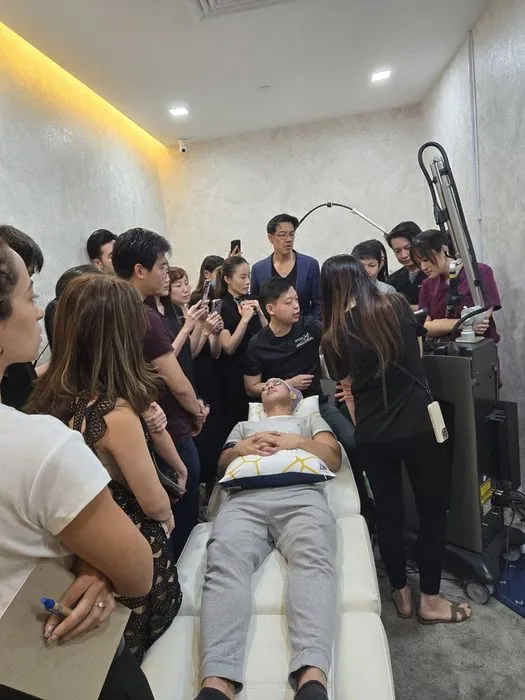
Energy work millimetres from the eye demands exactly the judgment international device manufacturers invite Dr Sin Yong to share — the same radiofrequency platform behind the VF Periorbital Eyelift:


“Hooded skin and a weak eyelid muscle look alike in the mirror — they are different problems with different right answers.”
— Dr Sin Yong
Lifting does not change the shape of a crease; it uncovers the crease you already have. A tapered double eyelid is a crease that starts narrow near the inner corner, often tucked inside the inner fold, and widens towards the outer corner. A parallel crease runs at a similar height from the inner to the outer corner, sitting above the inner fold. Some eyelids have a crease that is hidden or only partly visible, and some have none, which is usually called a monolid.

Hooding alters how a crease looks without altering the crease itself. As the skin above it loosens or the brow descends, the fold drapes over the lid: a tapered crease often disappears at the outer corner first, and a parallel crease can start to look narrower or uneven from side to side. The assessment checks whether the crease is still there beneath the hooded skin, and at what height.
Where it is, a non-surgical eyelid lift aims to un-bury it, so the tapered or parallel shape you were born with shows again. Converting a tapered crease into a parallel one, raising a crease or creating one where none exists is a different goal. That is double eyelid surgery, and it is referred to a plastic surgery specialist.

People with true ptosis, heavy skin redundancy or a wish to create or reshape a double eyelid crease tend to respond poorly, because energy treatment lifts and tightens what is there and cannot cut or re-form a crease.
Expected effects are warmth, redness and swelling around the eye, and after fractional laser, redness and fine crusting on the lid skin. These usually settle as the skin heals, and recovery varies between people. Less often there can be prolonged redness, pigment change (darkening or lightening, more likely in medium and darker skin), blistering, infection or a cold sore flare. Rarely the eye itself can be irritated, which is why protective eye shields are used. Eyelid skin is thin, so settings are conservative, but risk cannot be excluded entirely.
The fee depends on the area treated (brow and periorbital support, lid skin, or both), the device and consumables used, the number of passes or zones planned, and whether the lift is combined with another treatment. A written quote is given at consultation, after Dr Sin Yong has examined the crease, levator function, brow position and skin quality. The consultation also decides whether a non-surgical lift is advised at all, or whether surgical referral is the more appropriate route.
How quotes work at this practice: how we quote.
It uncovers the crease you already have; creating, raising or reshaping a crease is a surgical goal.
Hooded skin and brow descent can suit non-surgical lifting, while true ptosis from a weak muscle is referred for surgery.
Very often, yes. When the assessment shows hooded skin or brow descent with an intact double eyelid crease, a non surgical eyelid lift — focused ultrasound and radiofrequency around the brow and eye, with fractional laser for the lid skin — lifts the area without blepharoplasty. When the assessment shows true ptosis, surgery is the right tool and you will be told so honestly.
If your crease exists and the problem is heaviness above it, re-creating a crease you already own makes little sense. Double eyelid surgery is for building a crease; lifting is for un-burying one. The assessment tells you which situation is yours before anything is booked.
Droopy eyelid surgery — blepharoplasty or ptosis correction — cuts skin or shortens muscle. A non-surgical eyelid lift uses focused energy to tighten and elevate the tissues that have descended, with no incisions and your own crease preserved. They solve different anatomies, which is why assessment comes first.
Ptosis means the lid margin itself sits too low because the levator muscle that opens the eye is weak or stretched. Significant ptosis is corrected surgically — ptosis treatment with devices alone cannot repair a weak muscle. Distinguishing ptosis from hooded eyes is the single most important part of the eyelid assessment.
Hooded eyes describe skin folding over the lid so the crease disappears when the eyes are open. It is one of the three anatomies patients call droopy eyelids — and the one that tends to respond well to non-surgical lifting, because the eye itself opens normally.
It uses Volnewmer monopolar radiofrequency around the brow, temple and periorbital area — it does not use focused ultrasound — lifting the frame of the eye and tightening the support the eyelid sits on. The eyelid is lifted by lifting what holds it.
Fractional laser work on the eyelid is performed with protective eye shields in place throughout, and with conservative settings suited to the thinnest skin on the body. Safety protocols around the eye are precisely why this treatment belongs with an experienced physician.
A session is typically under an hour. Recovery after ultrasound and radiofrequency lifting depends on the settings and area, and is discussed at consultation, while laser lid resurfacing brings a few days of redness and fine crusting. The lift itself builds progressively over the following weeks as collagen remodels.
The cost depends on which anatomy is being treated and which combination of energy devices your assessment calls for, so it is quoted individually at consultation — and always confirmed with you before anything is done.
When skin redundancy is beyond what energy can retract, or when true ptosis needs muscle repair. In those cases surgery is the honest recommendation and a referral is made — the point of assessment-first care is that you end up with the right procedure, not the available one.
No — that is the point. Non-surgical lifting elevates the brow and tightens the lid support while leaving your crease and eye shape exactly as they are. Patients look like themselves, less tired.
Singapore's medical advertising rules restrict outcome photography online, so this page shows before-and-blurred composites only. Actual unblurred case photographs can be viewed in person during consultation at the clinic.
Question not answered here? Ask on WhatsApp, use the enquiry form, or browse 100 questions patients ask.
A non-surgical eyelid lift in Singapore at Dr Sin Yong's practice always begins with a structured eyelid assessment — crease position, levator function, MRD1 and brow position. Hooded eyes and brow descent with an intact double eyelid crease are lifted with focused ultrasound, radiofrequency and fractional laser without blepharoplasty; true ptosis is identified and referred for surgical correction. This information is educational and is not a substitute for a medical consultation.
Medically reviewed by Dr Sin Yong, MBBS (NUS), MRCS (Edinburgh) · Last updated 5 October 2026 · Editorial policy
Assessment-first eyelid lifting — hooded eyes and brow descent lifted without blepharoplasty; true ptosis identified honestly.
Replies within clinic hours: Mon–Fri 10am–8pm, Sat 11am–3pm · How consultations work · Prefer not to use WhatsApp? · Treatment finder
WhatsApp Dr Sin YongLeave your name, mobile number and email and the clinic will contact you directly. No obligation.