Published 21 September 2026 · Reviewed by Dr Sin Yong
Wart removal in Singapore depends on the lesion: a viral wart is a contagious, HPV-driven growth, while an 'age wart' (seborrhoeic keratosis) is a non-viral, non-contagious growth of skin maturity. The two look similar but are treated differently, so assessment confirms which one it is first.
Half the 'warts' I am asked to remove are not warts at all. True viral warts are contagious growths driven by human papillomavirus, commonest on hands and feet. Seborrhoeic keratoses — the 'age warts' that multiply across faces and trunks from the forties onward — are non-viral, non-contagious growths of skin maturity. They look superficially similar, spread entirely differently, and the distinction changes everything about treatment.
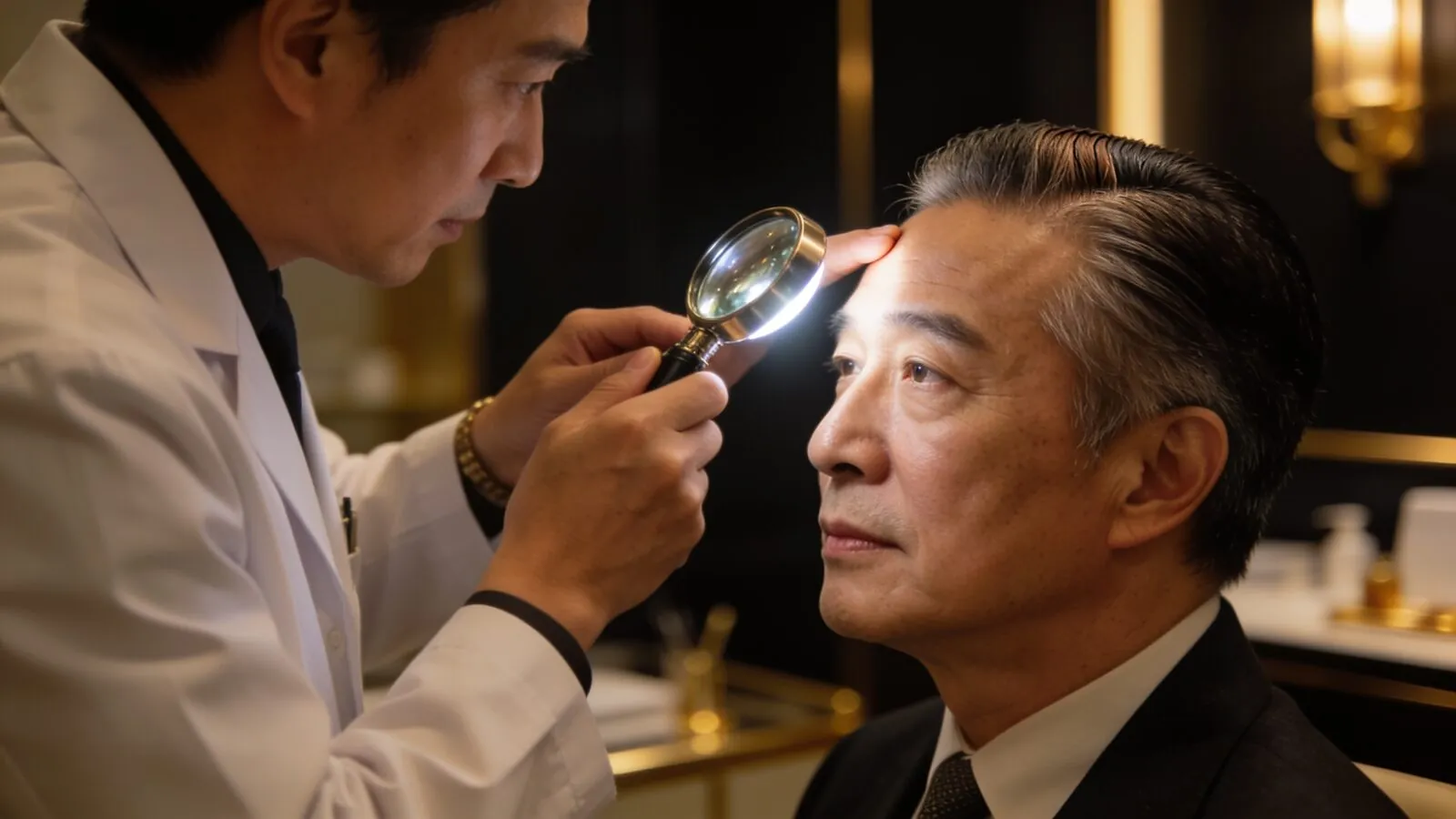
Stuck-on and waxy versus rough and disruptive — the surface tells the story, and assessment confirms it.
Key facts
Viral wart
An HPV-driven epidermal growth; contagious by contact and self-spread through scratching or shaving
Seborrhoeic keratosis
A benign, non-viral proliferation of surface keratinocytes — the 'age wart' or 'stucco-on' lesion of maturity
HPV
Human papillomavirus — over 200 types; common warts involve types that infect skin keratinocytes
Distribution
Viral warts favour hands, feet and shaving areas; seborrhoeic keratoses favour face, scalp and trunk
Black dots
Thrombosed capillaries in a viral wart's surface — a distinguishing feature under magnification
Removal methods
Cryotherapy, radiofrequency/laser ablation, curettage — matched to lesion type, site and number
Contagiousness
Viral warts: yes, including self-spread. Seborrhoeic keratoses: never
Two lesions, one lay name
A viral wart is an infection: HPV persuades surface skin cells to over-multiply into a rough, disruptive papule, and the virus in that papule can seed new warts — on you, and occasionally on others. A seborrhoeic keratosis is not an infection at all: it is a benign proliferation that skin produces with the decades, sitting on the surface with a characteristic waxy, 'stuck-on' look, as though it could be peeled off. One spreads and recruits; the other simply multiplies with age on its own schedule. Everything downstream — urgency, method, prevention — follows from which one you have.
“One of these lesions is an infection. The other is maturity. Treating them identically is how both get treated badly.”
Dr Sin YongOn viral warts versus seborrhoeic keratoses
How to tell them apart
Viral warts are rough, firm, and interrupt the skin's fingerprint lines; under magnification they show pinpoint black dots — thrombosed capillaries — and they favour hands, fingers, soles and shaving zones. Seborrhoeic keratoses look painted on: waxy or warty plaques in tan, brown or near-black, with a matte, keratotic surface, scattered across the temples, cheeks, trunk and hairline in patterns that often echo a parent's. Age helps too — a new crop of lesions in the fifties is far more often seborrhoeic keratoses. But dark or changing lesions matter: a seborrhoeic keratosis can occasionally mimic a melanoma and vice versa, which is why the confident diagnosis belongs in a clinic, not a mirror.
Removing viral warts properly
Because a viral wart is infected tissue, removal aims to destroy it fully while the immune system deals with the virus. Options include cryotherapy in cycles, ablation by radiofrequency or laser, and curettage for suitable lesions — chosen by site, depth and number. Plantar warts on weight-bearing soles are the stubborn ones, often needing repeated cycles regardless of method, and honesty matters here: recurrence after apparently complete treatment is common with warts everywhere in the world, because virus can persist in adjacent clinically normal skin. Persistence wins; single-session promises do not.
Removing age warts
Seborrhoeic keratoses are the more grateful lesion: superficial by nature, they ablate or curette off cleanly under local anaesthesia, typically in one sitting, with modest aftercare and no virus to recur. Multiple facial lesions are commonly cleared in a single session. The main considerations are cosmetic — controlled depth to avoid marks, and sun protection during healing, since post-inflammatory pigmentation is the principal risk in our climate and skin types. New keratoses will appear elsewhere over the years because the tendency is constitutional; that is maturity, not relapse.
When a 'wart' deserves a doctor promptly
Any lesion that is bleeding without provocation, growing quickly, ulcerating, intensely dark or irregular, or simply behaving unlike its neighbours deserves examination rather than removal-by-assumption. The point of assessment before ablation is the same as with moles: destroyed tissue answers no questions. It takes minutes to be sure, and the rare occasions when 'just a wart' is something else are exactly the occasions the assessment exists for.
Wart removal — which “wart” are you asking about?
Wart removal is searched as one thing and covers two unrelated lesions. A viral wart is caused by human papillomavirus, is contagious, and can seed to other sites and other people. An age wart — seborrhoeic keratosis — is a benign overgrowth of keratinocytes, carries no virus, and cannot be caught or passed on.
That distinction changes the approach entirely. Viral wart removal has to account for virus present in skin that still looks normal, which is why recurrence at the margins is common and why treatment is frequently staged. Age wart removal has no virus to account for, so it is a question of clearing the lesion at the right depth without overtreating the skin around it. Treating one as though it were the other is the usual reason a “wart” keeps coming back.
What are the wart removal options in Singapore?
Wart removal in Singapore uses the same small set of methods as elsewhere: topical salicylic acid, cryotherapy, electrocautery or radiofrequency, curettage and laser ablation. None of them kills the virus itself; each destroys the infected tissue while the immune system deals with the HPV, which is why viral warts can recur after any method.
Salicylic acid, applied regularly over weeks, is often a first step for small common warts. Cryotherapy freezes the wart and is repeated at intervals; liquid nitrogen, at about −196 °C, is the conventional agent. Histofreeze is a brand of cryotherapy device that uses a liquefied gas mixture rather than liquid nitrogen, applied through a foam-tipped applicator at around −55 °C. It is a way of delivering cryotherapy rather than a different treatment, so the same repeat cycles and recurrence apply. Blistering and pale or dark marks, more noticeable in darker skin, can follow any freezing method.
Electrocautery, radiofrequency, curettage and laser ablation remove the wart under local anaesthesia and are generally kept for warts that have not responded to simpler treatment. Plantar warts on the soles are often slow to clear whatever the method, and persistent warts, genital warts and warts in people with lowered immunity are usually managed by a GP or dermatologist. Whatever the method, the lesion is confirmed as a wart first.
Viral wart vs age wart (seborrhoeic keratosis) vs skin tag
Feature
Viral wart
Age wart (seborrhoeic keratosis)
Skin tag
Cause
Human papillomavirus (HPV) infection of the skin
A benign, non-viral overgrowth of surface skin cells that becomes commoner with age
A benign outgrowth of loose collagen and small vessels at friction sites
Contagious
Yes, by direct contact and by self-spread through scratching or shaving
No
No
Look and feel
Rough and firm, interrupting the fingerprint lines; may show tiny black dots
Waxy, stuck-on plaque in tan, brown or near-black
Soft, skin-coloured or slightly darker, hanging from a narrow stalk
Common sites
Hands, fingers, soles and shaving areas
Face, scalp, chest and back; not the palms or soles
Neck, underarms, eyelids, groin and under the breasts
Usual removal approach
Salicylic acid, cryotherapy in repeat cycles, radiofrequency or laser ablation, or curettage
Cryotherapy, curettage, electrocautery or ablative laser once confirmed benign
Snip excision, or radiofrequency or laser ablation once confirmed as a tag
After removal
Recurrence is common, because virus can persist in nearby normal-looking skin
No virus to recur; new lesions can appear elsewhere over the years
Rarely regrows at the same spot; new tags can form at other friction sites
Warts & Age Warts — Frequently Asked Questions
A true wart is a contagious growth caused by HPV infection of the skin. An 'age wart' — seborrhoeic keratosis — is a benign, non-viral growth that appears with the decades. They can look similar, but one spreads by contact and the other never does.
Viral warts, yes — by direct contact, shared floors (plantar warts), and self-spread through scratching or shaving. Seborrhoeic keratoses are not contagious at all, no matter how many appear.
Almost certainly seborrhoeic keratoses — they multiply gradually from the forties onward, often following family patterns. Each new one is a new lesion, not a spreading infection, and removal of one does not provoke others.
Cryotherapy in repeat cycles, radiofrequency or laser ablation, or curettage — chosen by site, size and number. Plantar (sole) warts are the most stubborn and commonly need several sessions regardless of method. Recurrence is possible with any technique because virus can persist in surrounding skin.
Being superficial and non-viral, they ablate or curette off cleanly under local anaesthesia, usually in one sitting — including multiple facial lesions in one session. Healing is a small crust for about a week per site.
Seborrhoeic keratoses are benign and do not become melanoma. The practical issue is mimicry — a dark, irregular seborrhoeic keratosis can resemble a melanoma and occasionally the reverse. That is a reason for assessment of dark or changing lesions, not a reason for alarm about the ones you have had for years.
Viral warts in adults tend to persist and can spread, so treating them — especially early, small ones — is reasonable. Seborrhoeic keratoses need removal only when they catch, itch, or bother you cosmetically. Neither is an emergency; both are worth a proper look first.
HPV can remain in clinically normal skin around a treated wart, so recurrence after complete visible clearance is common and does not mean the treatment was done badly. Repeat cycles, and patience, are part of honest wart management everywhere.
A viral wart is rough and firm, sits flat or slightly raised, and is caused by a virus that can spread. A skin tag is soft and smooth, hangs from a narrow stalk at a friction site such as the neck or underarms, and is not contagious. Age warts, or seborrhoeic keratoses, are a third lesion with a waxy, stuck-on look. Each is removed differently, so the lesion is examined before anything is done.
Over-the-counter freezing kits use the same principle as clinic cryotherapy and are sold for small common warts on the hands or feet. They are not suited to the face, the genitals, a lesion you are unsure about, or the feet of anyone with diabetes or poor circulation. A growth that bleeds, changes or does not look like your other warts should be examined rather than frozen.